


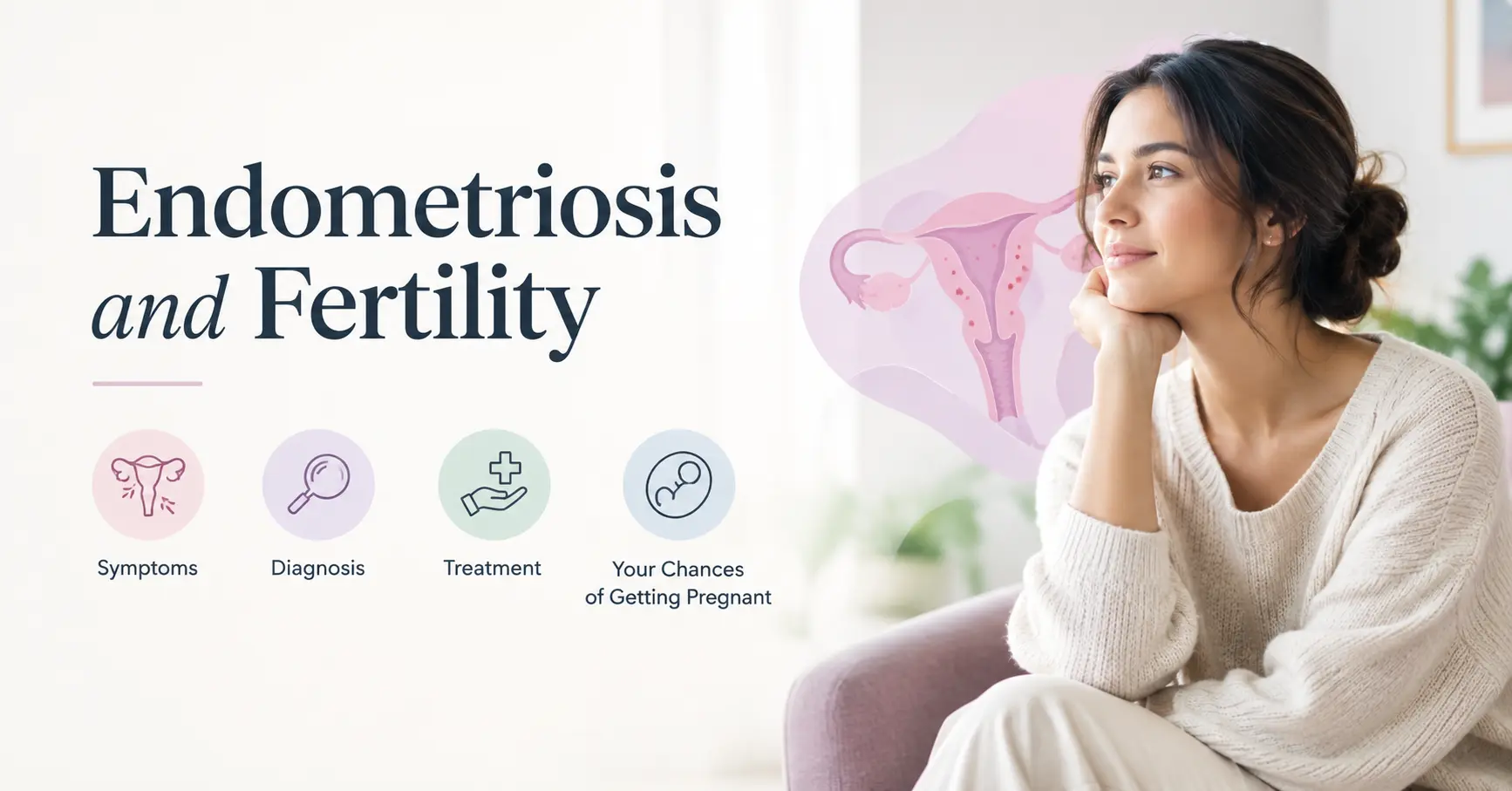

Endometriosis and Fertility: Symptoms, Diagnosis, Treatment and Your Chances of Getting Pregnant
You’ve heard the word endometriosis, and now you’re wondering what it means for your future.
Can you still have a baby?
Will treatment help or get in the way?
Let’s go through it together, one piece at a time.
What Is Endometriosis, and How Common Is It?
Endometriosis happens when tissue similar to your womb lining grows somewhere it shouldn’t.
Usually that’s on your ovaries, your fallopian tubes, or the lining of your pelvis. Each month, this tissue reacts to your hormones just like your womb lining does. It thickens. It breaks down. It bleeds.
The problem is, it has nowhere to go, so it leaves behind inflammation, scarring, and pain instead.
It affects around 1.5 million women and people assigned female at birth in the UK, roughly as many as live with diabetes, according to Endometriosis UK.
It’s the second most common gynaecological condition in the country.
Yet on average, it takes 9 years and 4 months from your first GP visit to get diagnosed, the same source reports. That’s a long time to feel dismissed. You’re not imagining it.
Endometriosis Symptoms You Shouldn’t Ignore
Some women barely notice anything.
Others deal with pain that takes over their whole life. NICE, the National Institute for Health and Care Excellence, says to raise the possibility of endometriosis with your GP if you notice:
- Pelvic pain that sticks around for six months or more
- Periods so painful they stop you going about your day
- Pain during or after sex, or when you poo or wee
- Bloating, fatigue, or heavy periods
- Trouble getting pregnant
If a few of these sound familiar, say so out loud to your doctor. Name the symptoms directly.
Many women carry these signs for years before anyone joins the dots.
Can Endometriosis Cause Infertility?
Yes, it can make things harder, but it doesn’t hit every woman the same way.
Around 30% to 50% of women with infertility have endometriosis, and roughly 40% of women with endometriosis experience some degree of infertility, according to the World Health Organization and research in BMC Women’s Health.
Plenty of women with endometriosis still conceive without any help, especially with milder cases.
Why does the link exist in the first place? A few reasons:
- Scar tissue can block or twist your fallopian tubes, so egg and sperm never meet.
- Inflammation in your pelvis can lower egg quality and make it harder for an embryo to implant.
- Endometriomas, cysts on your ovaries, can shrink your ovarian reserve, either on their own or through surgery to remove them.
- Deep endometriosis near your bowel or bladder can distort your pelvic anatomy even more.
Your stage plays a role too. Doctors grade endometriosis from stage I, minimal, up to stage IV, severe.
Mild cases often barely touch your fertility. More advanced stages tend to lower your natural chances, though as you’ll see below, that doesn’t mean IVF stops working for you.
How Is Endometriosis Diagnosed in the UK?
For a long time, the only way to confirm endometriosis was laparoscopy, a keyhole surgery where a surgeon looks inside your pelvis with a small camera.
That’s part of why diagnosis has taken so long for so many women. NICE updated its guidance in November 2024 to speed things up.
Your GP can now offer you a transvaginal ultrasound as soon as endometriosis looks likely, even if your pelvic exam comes back normal, according to NICE’s updated guideline.
Specialist ultrasound is now recommended alongside, or instead of, MRI for spotting deep endometriosis, which should mean fewer months spent waiting for answers.
Laparoscopy still matters when scans aren’t clear enough, or surgery is needed anyway.
It just isn’t your only path forward. If you think you might have endometriosis, ask your GP for a transvaginal ultrasound and a referral to a gynaecologist.
Endometriosis Treatment for Fertility: What Helps You Conceive
Treating endometriosis for pain and treating it to help you conceive aren’t the same thing. That’s worth knowing upfront.
Hormonal treatments like the pill, progestins, or GnRH medications work well for pain, but they switch off ovulation, so they won’t help you get pregnant.
If a baby is your goal right now, these shouldn’t be handed to you as a fertility fix.
Surgery works differently. Laparoscopic surgery shows good fertility outcomes in cases of superficial endometriosis. For endometriomas, NICE now recommends either laparoscopic cystectomy, which removes the cyst along with its wall, or laparoscopic drainage and ablation. Laparoscopy also aims to excise all the endometriosis lesions inside the pelvis and to divide the scar tissue.
Both can improve your odds of conceiving naturally.
Cystectomy tends to work a bit better, but drainage and ablation may protect more of your ovarian reserve, so it’s worth talking through the trade-offs with your surgeon, based on NICE’s 2024 update.
For deep endometriosis near your bowel, bladder, or ureter, NICE recommends an honest conversation with your surgeon about whether surgery makes sense while you’re trying to conceive.
It can help, but it isn’t always better than going straight to IVF.
Getting Pregnant With Endometriosis: What the Path Usually Looks Like
Your next step really depends on where you’re starting from.
Mild endometriosis, nothing else in the way? You might just keep trying naturally, sometimes with surgery to clear visible lesions.
Moderate to severe, or no luck so far? IUI might come up, though it tends to work less well as your endometriosis advances.
Damaged tubes, endometriomas, or simpler treatments that haven’t worked?
IVF is usually your strongest option, since it sidesteps many of the physical barriers endometriosis creates.
Endometriosis and IVF: What the Research Says
This is the question most people are really asking. The honest answer: endometriosis and IVF work together well, even if the numbers run a little lower than for women without the condition.
A 2025 study in Human Reproduction followed women through three IVF or ICSI cycles in a row.
Women with endometriosis or adenomyosis reached a cumulative live birth rate of 70% by their third cycle. Women without either condition reached 85.7%.
Earlier research on severe, stage III to IV endometriosis found a similar story: lower odds per cycle, but a narrower gap once several cycles were added together, frozen transfers included.
There’s something that might surprise you. When donor eggs come into play, that gap tends to close completely.
One study comparing donor-egg outcomes found live birth rates of 28% for women with stage III to IV endometriosis and 27.2% for women without it. Basically no difference.
Endometriosis affects your egg quality and ovarian reserve far more than it affects your uterus’s ability to carry a pregnancy.
If you’re weighing up IVF with donor eggs because of endometriosis-related damage to your ovaries, or you just want your own numbers instead of a national average, IVF London can walk you through what your case might look like.
Book a free mini consultation service at IVF London to get expert opinion!
Where This Leaves You
Endometriosis can make getting pregnant harder. It doesn’t take that chance away from you.
Diagnosis is finally moving faster thanks to updated NICE guidance, treatment options are better understood than a few years ago, and IVF keeps delivering solid outcomes even in advanced cases.
You don’t have to figure this out alone.
A fertility specialist can look at your stage, your history, and what you’re hoping for, then help you find the path that gives you your best real shot at the family you want.

