Donor Egg IVF: Common Myths, Facts and What the Science Says
In 2024, 1 in 5 IVF births in the UK involved donor eggs, sperm, or embryos, the highest share on record, according to the HFEA’s latest annual report.
If you’re exploring donor eggs for IVF, you’re not on some rare, unusual path.
You’re joining a growing number of people who’ve found this works for them. But you’ve probably also heard a few things about it that don’t quite add up. Let’s go through what’s actually true, together.
For many people, being told they may need donor eggs can bring up mixed emotions. It’s completely normal to feel uncertain, disappointed, hopeful, or all three at once.
What Is Donor Egg IVF, Exactly?
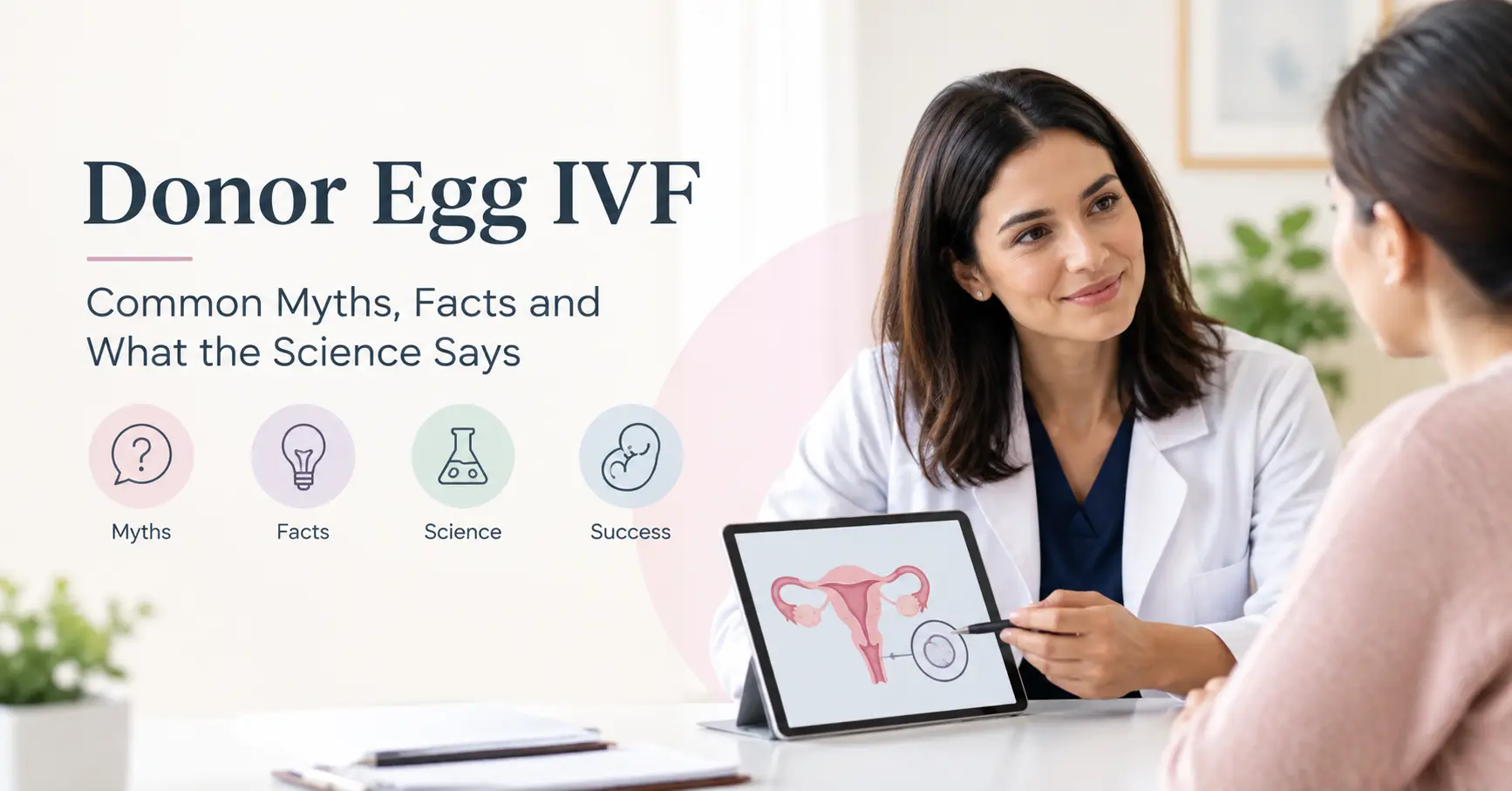
Donor egg IVF simply means using eggs from a screened, healthy donor instead of your own.
Your doctor fertilises that egg with sperm from your partner or a donor, then transfers the resulting embryo into your uterus.
From there, everything else is the same as any pregnancy. You carry your baby, you give birth, and you’re the legal mother the second your child arrives. The only difference is where the egg came from.
You might be pointed toward IVF with donor eggs if your ovarian reserve has dropped, if your own eggs haven’t led to a pregnancy after a few tries, or if you carry a genetic condition you’d rather not pass down.
Understand how clinics find the right donor for you!
Donor Egg IVF Success Rate: What the Numbers Actually Say
This is usually where people start feeling anxious, so let’s slow down and look at what the HFEA, the UK’s fertility regulator, has actually published.
- Across all IVF patients in 2024, the average birth rate per embryo transferred sat at 30%. Patients aged 18 to 34 had the best odds, and patients aged 43 to 44 had the lowest, per the HFEA’s Fertility Treatment 2024 report.
- Switch to donor eggs, and your age stops driving the outcome. Birth rates per embryo transferred stay fairly steady across every age group and hold above 25%, because it’s the donor’s age, not yours, that determines egg quality.
- A 2025 study that went through more than three decades of HFEA records found that women over 43 rarely succeed using their own eggs, while donor eggs kept working just as well no matter how old the recipient was, as covered by Population Studies.
So if you’ve been searching for the donor egg IVF success rate, here’s what it comes down to.
Your birthday matters far less than you’d expect. The donor’s age and health matter a lot more.
The Donor Egg IVF Myths You’ve Probably Heard
You’ve likely come across a few of these already. Let’s clear them up one at a time.
Myth 1: The Baby Won’t Feel Like Yours
If this thought has crossed your mind, you’re not alone, and it makes sense that it would. But it isn’t supported by what we actually know.
You carry your baby for nine months. Your body shapes how that baby grows. You go through labour together.
Research on donor conception shows the same thing again and again: bonding comes from pregnancy and caregiving, not from shared DNA.
Legally, you’re the mother from the moment your baby is born, no matter whose egg was used.
Myth 2: Donor Eggs Guarantee a Baby
No honest clinic will tell you this.
Your uterine lining, your hormone levels, your partner’s sperm quality, and your general health still all play a part.
Donor eggs can improve your chances a great deal, especially if your own egg quality has declined.
They just can’t promise a result.
A good clinic will sit with you and talk through your own specific chances instead of handing you a generic percentage.
Myth 3: Egg Donors in the UK Stay Anonymous Forever
This used to be true, but the law changed back in 2005. If your donor registered after 1 April 2005, your child can ask for identifying details about that donor once they turn 18.
The first group of donor-conceived people born under this rule reached 18 in 2023, and the HFEA expected close to 1,300 people to become eligible in 2024, according to its own press release.
You and your donor still won’t meet or exchange contact details during treatment. But the old idea that anonymity lasts forever just isn’t accurate anymore.
Myth 4: Donor Egg IVF Is Unregulated or Risky for Your Child
It’s actually one of the most closely watched parts of fertility care in the country.
Donors usually need to be between 18 and 35. Before anyone can donate, they go through genetic screening, infectious disease testing, and a psychological assessment.
Every clinic involved is licensed and inspected by the HFEA. One donor’s eggs can only help create up to 10 families in the UK, a rule that’s been in place since 2006.
Paying someone for their eggs is illegal here.
Donors receive a fixed £985 per cycle to cover their time and costs, which keeps donation an act of goodwill rather than a transaction.
If you’re weighing up IVF with donor eggs and wondering how any of this applies to you, IVF London can sit down with your history and walk you through what treatment would actually look like in your case.
Book a free mini consultation at IVF London!
Donor Egg IVF in the UK: What You Should Know Before You Start
A few practical things worth knowing before treatment begins:
- You’re always the legal parent once your baby is born, never the donor.
- Donors can’t be paid for their eggs, only reimbursed for time and expenses, currently capped at £985 per cycle.
- You can choose an anonymous donor matched to your appearance, or in some cases use someone you know, like a friend or family member.
- Wait times for a matched donor vary from clinic to clinic, which is why many people also look into licensed donor banks or overseas donor programmes that still follow HFEA import rules.
Top foods to boost fertility and enhance egg quality naturally
Why People Choose Donor Eggs
People may consider donor egg IVF if they:
- Have a low ovarian reserve.
- Have experienced multiple unsuccessful IVF cycles.
- Have gone through early menopause.
- Carry a genetic condition they do not wish to pass on.
- Have had previous treatment where embryo quality was affected by egg quality.
Is Donor Egg IVF Right for You?
If your egg reserve has dropped, your past cycles haven’t worked, or you’re carrying a genetic condition you don’t want to pass on, it’s worth having an honest conversation with your clinician about donor egg IVF.
The evidence keeps pointing the same way: egg quality shapes your outcome more than almost anything else, and donor eggs deal with that directly.
What the statistics can’t tell you is how this choice will feel once you’re actually living it.
That part deserves an unhurried conversation with people who’ll look at your real chances, not just a national average.
When you’re ready, IVF London’s team is there to talk through what your next step could look like.
Choosing donor egg IVF is a deeply personal decision. For many families, it provides a path to pregnancy when other options have not been successful. The right choice is the one that feels right for your circumstances, values, and future family plans.