


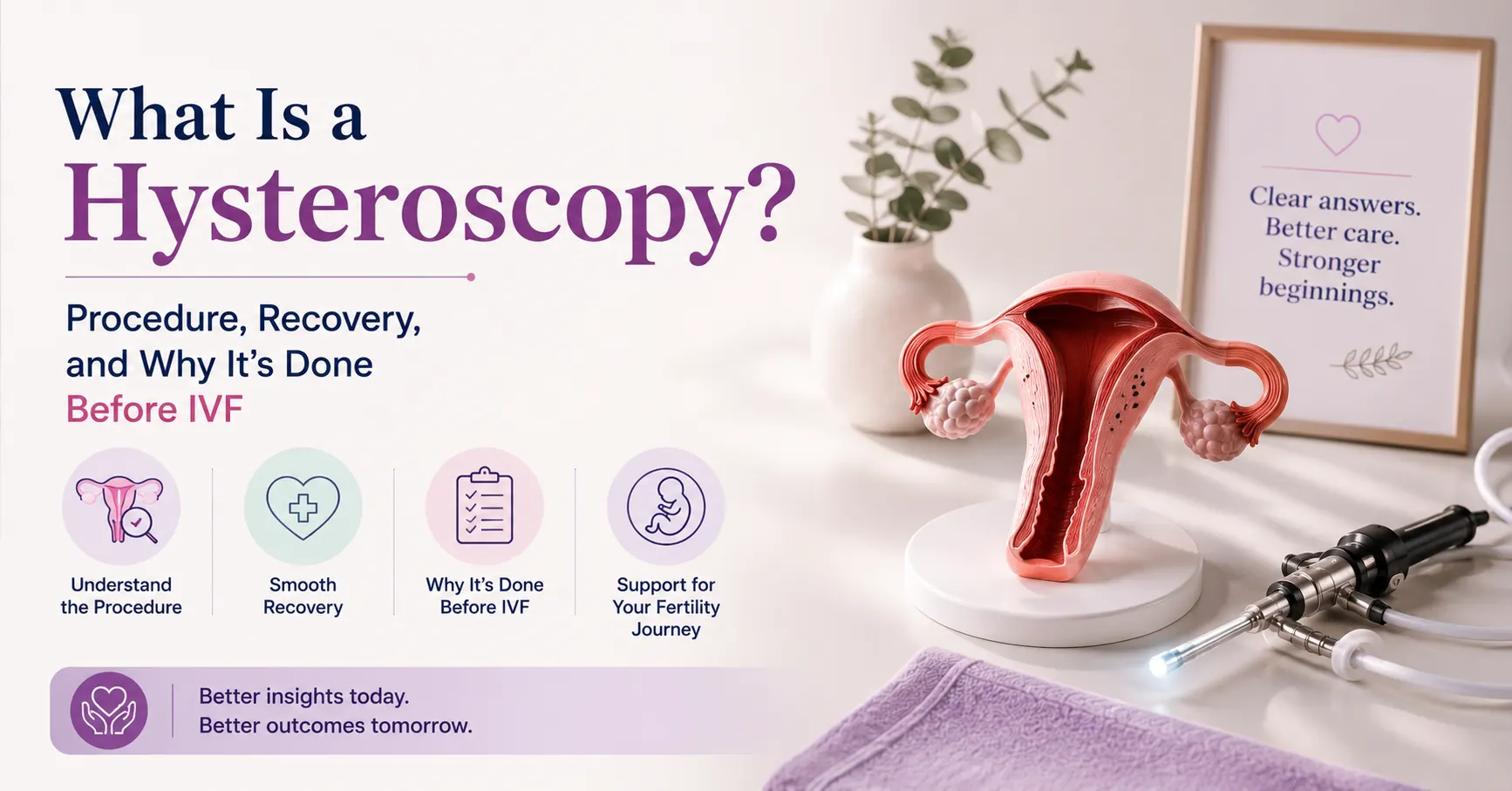

What Is a Hysteroscopy? Procedure, Recovery, and Why It’s Done Before IVF
Your fertility specialist just brought up a hysteroscopy, and now you’re left with questions.
What does it involve? Does it help IVF succeed, or is it just another appointment on an already long list?
Here’s a plain breakdown of the hysteroscopy procedure, what hysteroscopy recovery feels like, and why hysteroscopy is done before IVF for some patients and skipped for others.
What Is a Hysteroscopy?
It’s a short look inside your uterus.
Your doctor passes a thin, lighted telescope, called a hysteroscope, through your cervix.
No cuts. No incisions. A little fluid opens up the uterine cavity so your doctor can see what’s really going on, right there on a screen.
That view matters because small things can quietly block implantation.
Polyps, fibroids, scar tissue, or an unusual shape to the uterus don’t always show up clearly on a standard scan, but a hysteroscope tends to catch them.
Types of Hysteroscopy: Diagnostic vs Operative
There are two versions of this procedure, and the difference comes down to whether anything gets treated on the spot.
- Diagnostic hysteroscopy is purely a look. It identifies irregularities in the uterine lining without touching them.
- Operative hysteroscopy goes a step further. If your surgeon spots a polyp, a small fibroid, or scar tissue, they can often remove it during the same visit.
Many clinics now combine both into a single “see and treat” appointment. You go in for a look and sometimes leave with the problem already sorted.
Hysteroscopy Procedure: What to Expect Step by Step
Most hysteroscopies are outpatient. You show up, the procedure happens, and you’re home the same day. Roughly, here’s how it goes.
Clinics usually schedule it for the first half of your cycle, shortly after your period ends, since the uterine lining is thinnest then and easiest to examine. Anaesthesia varies by case.
Some women need none at all; others get local anaesthesia or light sedation, depending on what the doctor expects to find or treat.
The procedure itself typically runs five to thirty minutes. A longer session usually means treatment happened alongside diagnosis, not just a look around.
As for how it feels, expect cramping similar to period pain while the hysteroscope passes through your cervix.
Most women describe it as uncomfortable, not painful. Afterward, you rest for a short while before heading home.
If you had sedation, you’ll need someone to drive you.
Hysteroscopy Recovery Time: Aftercare and Warning Signs
How fast you bounce back depends on what happened during the procedure.
A diagnostic-only visit tends to heal quickly.
Treating a polyp or scar tissue in the same session adds a little more downtime, though nothing dramatic.
A few practical points worth keeping in mind:
- Light spotting or mild cramping for a day or two is normal and nothing to worry about.
- Hold off on tampons, douching, and sex for around two weeks, or however long your clinic recommends.
- Baths, swimming, and hot tubs can wait until you’ve healed.
- Most women are back at work within a day or two.
- Heavy bleeding, severe pain, fever, or unusual discharge are worth a call to your clinic. These signs point to something that needs a closer look.
Complications are genuinely rare.
Research on operative hysteroscopy puts uterine perforation at roughly 1 to 2 percent of cases, and most of these get caught and managed during the procedure itself. Serious infection happens even less often.
Still unsure how hysteroscopy fits into your own plan?
Speak with the IVF London team, and we’ll talk you through what makes sense given your history.
Discover Why IVF London Is the Right Choice for You
Why Is Hysteroscopy Done Before IVF? What the Evidence Shows
This is the part where patients tend to get mixed messages, so it helps to lay out what the research shows without dressing it up.
Unsuspected issues inside the uterus turn up more often than people expect, sometimes even when an ultrasound looks completely normal.
That’s the main reason hysteroscopy before IVF gets recommended in the first place. It picks up on things other scans occasionally miss.
Explore the Different Types of IVF Treatments
Hysteroscopy Before IVF After a Failed Cycle
This is where the case for hysteroscopy is strongest.
The TROPHY trial, a well-known UK study, found that women who’d already had a failed IVF attempt saw notably higher pregnancy rates after an outpatient hysteroscopy before their next try.
Reviews pooling several studies since then point in the same direction.
So if your last embryo transfer didn’t take, don’t be surprised if your clinic suggests a hysteroscopy before round two, mainly to rule out a physical cause.
Learn Your Next Steps After a Failed IVF Cycle
Hysteroscopy Before Your First IVF Cycle
Here, the evidence softens quite a bit.
A Cochrane review, one of the more rigorous sources in medicine, found only low-quality evidence that routine hysteroscopy improves outcomes before a first cycle.
Other reviews reach a similar conclusion. If your scans look clean and you have no symptoms, hysteroscopy probably won’t shift your odds much.
That said, it’s not pointless before cycle one.
Clinics tend to reserve it for specific flags: an abnormal scan, unexplained bleeding, or a uterine shape worth a second look.
Is Hysteroscopy for Fertility Right for You?
Your specialist might suggest hysteroscopy for fertility reasons if:
- You’ve been through one or more unsuccessful IVF cycles.
- Your ultrasound or HSG picked up something worth investigating further.
- You’re dealing with unexplained bleeding between periods or after menopause.
- Your history hints at scar tissue, a septum, or another structural issue.
None of that sound like you?
Your clinic may simply move ahead with IVF as planned, no extra step needed.
Every case looks a little different, so this really comes down to a conversation with a fertility team rather than a checklist you tick off alone.
Get yourself a free mini consultation today at IVF London to get personalized advice!
Conclusion
A hysteroscopy is quick, low-risk, and gives your doctor a view that scans alone can’t offer.
Whether it’s worth doing before your specific cycle depends mostly on timing.
After a failed cycle, the evidence leans in its favour.
Before a first cycle with clean scans, many clinics hold off. Either way, ask your team where you stand before deciding your next move.

