



Should You Choose PGT-A in IVF? Benefits, Risks & Who Needs It
If you’re going through IVF, you’re already making big decisions.
One of the hardest is whether to add PGT-A testing to your cycle. It’s often presented as a way to “improve success”, but the real answer is more nuanced than that.
PGT-A can be beneficial for some patients. For others, it may not change the outcome at all.
The key is understanding what it actually does, what it does not do, and whether it fits your situation.
Let’s break it down clearly. Read on.
What Does Genetic Testing of Embryos in IVF Actually Do?
During IVF, eggs are fertilised in the lab to create embryos.
Traditionally, embryologists select embryos based on how they look under the microscope, but appearance does not always reflect chromosomal health.
PGT-A (Preimplantation Genetic Testing for Aneuploidy) checks whether an embryo has the correct number of chromosomes.
Humans should have 46 chromosomes. If an embryo has extra or missing chromosomes, it is called aneuploid. These embryos often fail to implant or lead to miscarriage.
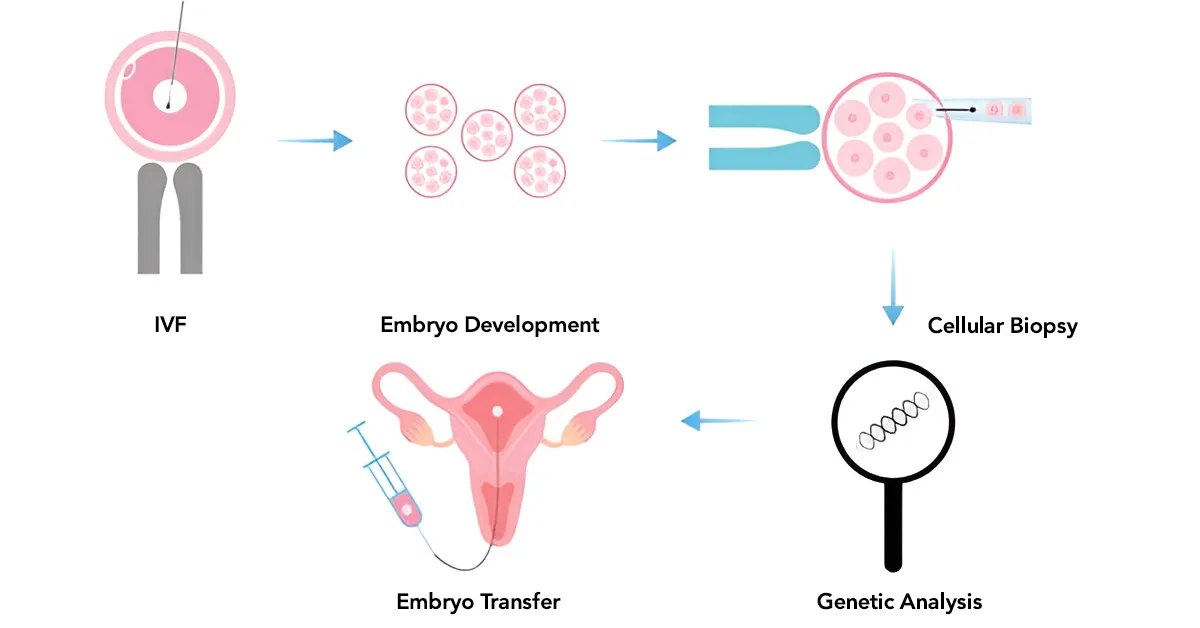
The process involves:
- Growing embryos to day 5 or 6 (blastocyst stage)
- Removing a few cells from the outer layer
- Sending those cells to a genetics lab
- Freezing the embryo while waiting for results
The goal is simple. Chromosomally normal transfer embryos, also called euploid, to reduce the chance of failed implantation or early pregnancy loss.
It is important to understand that this is a screening test. It does not guarantee a healthy baby.
PGT-A Testing Benefits
When used in the right group of patients, PGT-A testing benefits can be meaningful.
1. Lower miscarriage risk
Chromosomal abnormalities are the most common cause of first-trimester miscarriage.
If you have experienced repeated losses, this matters deeply. Transferring a euploid embryo lowers the risk of miscarriage caused by aneuploidy.
2. Better success per embryo transfer
The PGT-A testing success rate per transfer is often higher in women over 37 or 38.
That means when a tested embryo is transferred, the chance of implantation is stronger compared to transferring an untested embryo in the same age group.
But this does not automatically mean a higher overall live birth rate per IVF cycle. That distinction is important.
3. Fewer failed transfers
Each embryo transfer carries emotional weight. A failed transfer is not just a medical outcome.
It is a personal disappointment. PGT-A may reduce the number of transfers that fail due to chromosomal problems.
4. More confidence in single embryo transfer
When doctors know an embryo is euploid, they are more comfortable transferring just one embryo. This reduces the risk of twins and the medical complications that can come with multiple pregnancies.
PGT-A Testing Risks and Limitations
No medical decision is one-sided. There are real PGT-A testing risks to consider.
1. It is not a guarantee
PGT-A does not test for all genetic conditions. It only checks the chromosome number.
A euploid embryo can still fail to implant. Uterine factors, embryo quality, and other biological elements still play a role.
2. Embryo biopsy is a procedure
Although modern biopsy techniques are considered safe, they are still an intervention. A few cells are removed from the embryo. The risk of harm is low, but it is not zero.
For patients who produce very few embryos, even small risks matter.
3. Mosaic results create uncertainty
Sometimes embryos show a mix of normal and abnormal cells.
These are called mosaic embryos. Some mosaic embryos can still result in healthy births. Interpreting these results requires careful counselling.
4. Fewer embryos available for transfer
If you create only two or three embryos, and testing shows abnormalities, you may end up with nothing to transfer in that cycle.
That can be emotionally and financially difficult.
Who Should Seriously Consider PGT-A?
PGT-A is not designed for everyone. It tends to make the most sense in specific scenarios.
You may benefit if you:
- Are 37 or older
- Have had recurrent miscarriages
- Experienced multiple failed IVF transfers
- Produce several embryos and want a more precise selection
You may not need it if you:
- Are under 35 with strong ovarian reserve
- Have no history of pregnancy loss
- Produce very few embryos
The decision should never feel automatic. It should feel informed.
PGT-A Testing Cost: Is the Extra Expense Justified?
The PGT-A testing cost is high. It adds several thousand pounds to an IVF cycle in the UK.
This usually includes:
- Embryo biopsy
- Genetic laboratory testing
- Embryo freezing
- Storage fees
For some patients, avoiding multiple failed transfers may reduce long-term costs. For others, the added expense may not improve outcomes.
Cost only makes sense when clinical benefit is likely.
Is PGT-A Testing Worth It?
A large single-centre study analysing 13,000 frozen embryo transfer cycles examined how PGT-A influenced outcomes across different age groups.
Among patients under 38, the use of PGT-A was associated with a 15% increase in live birth rates.
For patients over 40, the improvement was even more substantial, showing nearly 30% higher live birth rates compared to IVF cycles that did not use PGT-A.
When researchers evaluated outcomes across all age groups using advanced statistical modelling, they found that PGT-A was linked to almost double the odds of achieving a live birth compared to IVF without genetic testing.
The right answer, however, is still personal.
This is where expert guidance becomes essential.
Clinics such as IVF London focus on personalised fertility care.
A careful specialist will review your age, hormone levels, embryo development, and previous treatment history before recommending genetic testing for embryos as part of your IVF plan.
PGT-A is a clinical tool, not a guarantee. When used in the right setting, it can support more informed embryo selection.
When added without a clear indication, it may increase cost without meaningfully improving outcomes.
The Bottom Line
IVF already asks a lot of you. Financially. Emotionally. Physically.
When you’re in the middle of treatment, it’s easy to feel like every decision carries enormous weight. Try to approach each step with clarity rather than urgency.
Take time to understand your treatment plan as a whole. Know your numbers. Know your options and know what the next step actually changes.
It also helps to:
- Keep track of your reports and results so you feel informed
- Discuss realistic timelines instead of focusing only on best-case scenarios
- Protect your mental space by limiting outside noise and comparisons
- Check in with yourself and your partner about what feels sustainable
IVF is not just a medical process. It affects your daily life, your relationships, and your energy. Make decisions that align with your capacity, not just possibilities.
The decision should feel balanced, not pressured.
Ask questions. Understand the science. Look at your specific case because in IVF, the most powerful approach is not adding everything. It is choosing what truly makes sense for you. Here at IVF London, we have a team of fertility specialists who are experts at their work and always ready to guide you with your IVF journey. Book free mini consultations today with our clinical experts and allow us to address your IVF concerns.


