


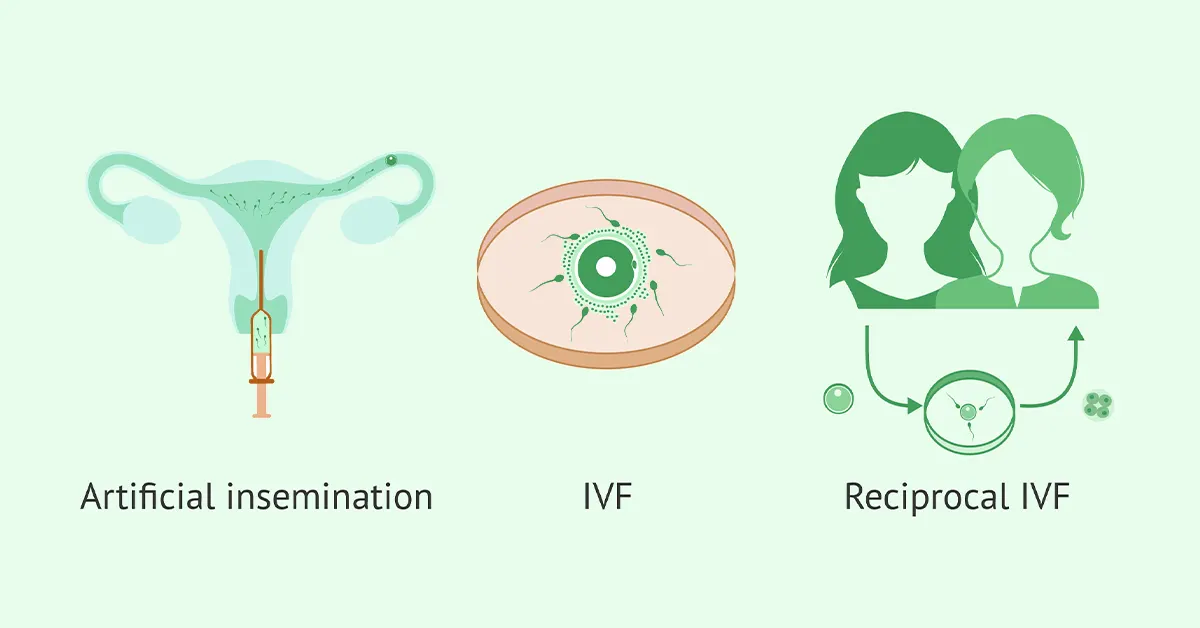

Reciprocal IVF for same-sex female couples: How does it work?
If you and your partner are a same-sex female couple thinking about starting a family, you may have come across the term reciprocal IVF (or the ROPA method).
At first, it can sound a bit technical. Once you understand the idea behind it, the concept is actually quite straightforward.
This treatment allows both partners to play a biological role in bringing a baby into the world. One partner provides the eggs. The other carries the pregnancy.
For many female couples, this shared involvement is what makes the process feel especially meaningful.
This approach is often referred to as shared motherhood IVF, and it is becoming increasingly common in fertility clinics.
If you are curious about how reciprocal IVF works, the steps are not very different from standard IVF.
The main difference is simply that both partners participate in different parts of the treatment.
What is reciprocal IVF?
Reciprocal IVF is a fertility treatment that allows two partners, often in female or transgender couples, to share the process of creating and carrying a child.
Instead of one person going through the entire IVF cycle, both partners take part.
The process usually looks like this:
- One partner provides the eggs
- Donor sperm is used to fertilise the eggs in the IVF laboratory
- An embryo develops over several days
- The embryo is transferred into the uterus of the other partner
- That partner carries the pregnancy and gives birth
One partner becomes the genetic parent, while the other experiences pregnancy and childbirth
Why couples choose shared motherhood IVF
Every couple approaches fertility treatment differently. Some are simply looking for the quickest route to pregnancy.
Others want both partners to be part of the process in a physical and emotional way.
For many couples, shared motherhood through IVF provides that balance.
Couples often choose this option because:
- One partner may have stronger egg quality, while the other may be better suited to carry a pregnancy
- The shared experience can feel emotionally meaningful
- Some couples choose to swap roles in future pregnancies
There is no single right choice. What matters is finding an approach that works for you as a couple.
How does reciprocal IVF work?
If you are trying to understand how reciprocal IVF works, it helps to walk through the process step by step.
Here is what the treatment usually involves.
1. The first step is fertility testing
Before treatment begins, both you and your partner will go through a few routine fertility checks. This stage helps your doctor understand your reproductive health and decide how to plan the cycle. The tests themselves are fairly straightforward. They usually include hormone blood tests, ultrasound scans of the ovaries and uterus, and screening tests that fertility clinics carry out before IVF treatment.
Your doctor will also discuss your medical history and your fertility goals as a couple.
The purpose of these checks is to determine which partner is best suited to provide the eggs and which partner is in the best position to carry the pregnancy.
2. Ovarian stimulation
Once the treatment plan is in place, the partner providing the eggs begins ovarian stimulation.
This stage involves hormone injections taken over about two weeks.
The medication encourages the ovaries to produce several eggs during one cycle.
Normally, the body releases only one egg each month, so producing multiple eggs improves the chances of creating healthy embryos.
During this time, you will visit the clinic for monitoring appointments.
Doctors track how the ovaries are responding by checking follicle growth through ultrasound scans and measuring hormone levels through blood tests.
When the follicles reach the right size, the clinic schedules egg collection.
3. Egg retrieval
Egg retrieval is a short procedure carried out at the fertility clinic. Most patients find it much easier than they expected.
You will usually receive light sedation so you remain comfortable throughout the procedure.
Using ultrasound guidance, the doctor carefully collects the eggs from the ovaries with a fine needle.
The procedure typically takes around 20 minutes. After a brief recovery period at the clinic, most patients are able to go home the same day.
The collected eggs are then taken to the IVF laboratory for fertilisation.
4. Fertilisation using donor sperm
Because the treatment involves two female partners, donor sperm is needed to fertilise the eggs.
The sperm usually comes from a licensed sperm bank or an approved donor.
In the IVF laboratory, embryologists fertilise the eggs using one of two techniques:
- Conventional IVF, where eggs and sperm are placed together in a culture dish
- ICSI, where a single sperm is injected directly into each egg
Once fertilisation takes place, the embryos begin to grow.
5. Monitoring embryo development
Over the next few days, embryologists monitor the embryos as they develop.
They observe several factors that indicate embryo health:
- Cell division patterns
- The speed of development
- Overall embryo quality
Many IVF laboratories now use time-lapse incubators that photograph embryos during development.
This allows embryologists to observe growth continuously without disturbing the embryos.
The goal is to select the embryo that has the best chance of leading to a successful pregnancy.
6. Preparing the partner who will carry the pregnancy
While the embryos are developing in the lab, the partner who will carry the pregnancy begins medication to prepare the uterus.
The goal is to create the right environment for implantation.
Treatment typically includes:
- Estrogen medication to build the uterine lining
- Progesterone to support embryo implantation
Doctors monitor the uterine lining through ultrasound scans to make sure it is ready for embryo transfer.
7. Embryo transfer
Embryo transfer is the final step of the treatment cycle.
During this procedure, the selected embryo is placed into the uterus of the partner who will carry the pregnancy. A thin catheter is used to gently guide the embryo into position.
The procedure itself is quick and usually takes only a few minutes. Anaesthesia is not required, and most patients are able to return home shortly afterwards.
If implantation occurs, the pregnancy begins.
Reciprocal IVF success rate
Many couples want to understand the reciprocal IVF success rate before starting treatment.
Success rates vary depending on several factors. One of the most important factors is the age of the partner providing the eggs.
Other factors that influence success include:
- Egg quality
- Embryo development
- Uterine health of the partner carrying the pregnancy
- Donor sperm quality
- The technology used in the IVF laboratory
According to fertility data from the UK regulator, IVF birth rates for patients under 35 are around 35 percent per embryo transfer.
Some same-sex couples experience similar or even slightly higher success rates because infertility may not be the reason they are pursuing IVF.
A fertility specialist can help you understand what the chances might look like based on your individual situation.
Considering reciprocal IVF in the UK
If you and your partner are thinking about reciprocal IVF, the best first step is usually a conversation with a fertility specialist.
There is a lot of information online, but speaking with someone who understands the process can make things much clearer.
A consultation gives you the chance to talk through your situation, ask the questions that matter to you, and get a better sense of what the treatment journey might look like.
At IVF London, you can book a free mini consultation with our fertility consultants for an information exchange where our experts will guide you through the best options for your fertility care and treatments.
During this conversation, you and your partner can explore different treatment options, learn more about the process, and start figuring out what the next step might look like for you both.


