


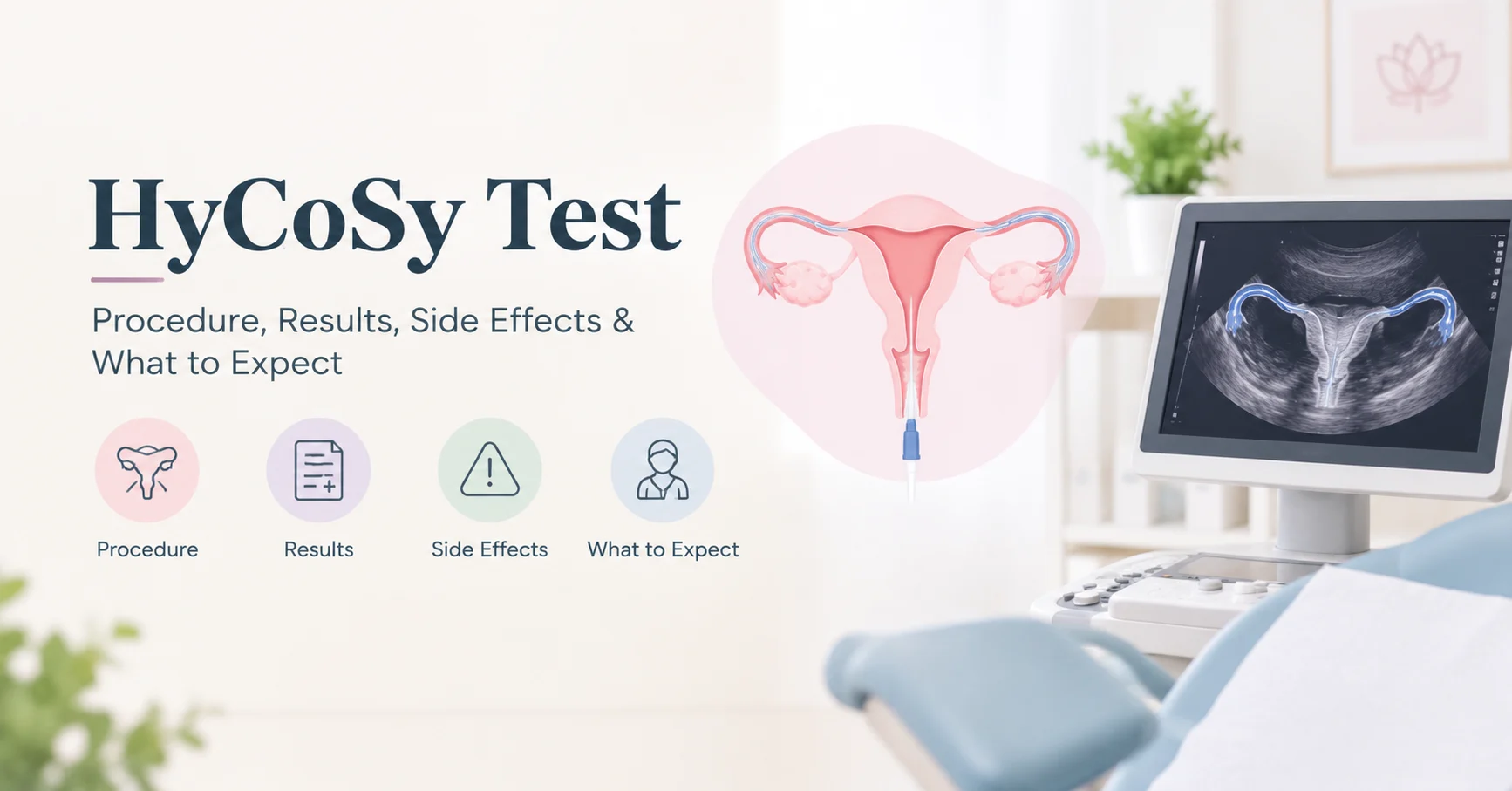

What Is a HyCoSy Test? Procedure, Results, Side Effects & What to Expect
HyCoSy
If your fertility specialist has suggested a HyCoSy, you probably have a few questions. What does it involve? Will it hurt? And what happens if something is found? Here is a clear, step-by-step guide so you know exactly what to expect.
Quick answer: A HyCoSy (hysterosalpingo-contrast sonography) is a short outpatient ultrasound test that checks whether your fallopian tubes are open. A small amount of special fluid or foam is passed into your womb through a thin tube, and an internal ultrasound scan watches it flow through the tubes. It takes about 15-30 minutes, needs no anaesthetic and uses no X-rays. Most people feel period-like cramping that settles quickly. Results are usually shared on the day.
Key takeaways
- A HyCoSy checks your fallopian tubes and the shape of your womb in one appointment.
- NICE recommends it as an effective alternative to an X-ray tube test (HSG) where expertise is available.
- It is usually done after your period finishes and before ovulation, typically around days 5-12 of your cycle.
- You need a negative chlamydia test or antibiotics beforehand, and you must not be pregnant.
- Side effects are usually mild: cramping, spotting and watery discharge for a day or two.
- The risk of infection is low, around 1 in 100.
- Open tubes are the most common result. If a tube looks blocked, further tests or IVF may be discussed.
If you are trying to conceive and want your tubes checked, you can Book a Free Consultation with our fertility team.
What is a HyCoSy test?
HyCoSy stands for Hysterosalpingo-Contrast-Sonography. The name breaks down simply: hystero means womb, salpingo means fallopian tubes, contrast is the fluid used, and sonography means ultrasound. It is sometimes called a tubal patency test, a fallopian tube test or a “bubble test”.
Your fallopian tubes carry the egg from the ovary to the womb, and they are where sperm usually meets the egg. They cannot be seen clearly on a normal scan. A HyCoSy makes them visible by filling them with a fluid that shows up brightly on ultrasound.
HyCoSy vs HyFoSy: what’s the difference?
You may also see the term HyFoSy (hysterosalpingo-foam sonography). It is a newer version of the same test that uses a gentle foam instead of fluid. The foam stays in the tubes a little longer, which can make them easier to see. Many clinics now use foam, and the two terms are often used interchangeably. [Clinic to confirm which method IVF London uses.]
What does a HyCoSy check?
- Whether your fallopian tubes are open (patent) – the main purpose.
- The shape of your womb cavity – it can show polyps, fibroids, scarring or an unusual womb shape.
- Your ovaries – a scan beforehand can show cysts and your antral follicle count, a sign of egg reserve.
Why is a HyCoSy done?
Blocked or damaged tubes are a common cause of female infertility. A HyCoSy is usually recommended:
- as part of routine female fertility investigations after trying to conceive for a year, or six months if you are 35 or over
- before starting ovulation induction or IUI, where open tubes are essential
- if you are using donor sperm and want to check your tubes before IUI
- after a past infection, ectopic pregnancy or abdominal surgery that may have affected the tubes
What UK guidance says
The NICE fertility guideline recommends checking the tubes for people who are not known to have conditions such as pelvic infection, previous ectopic pregnancy or endometriosis. It advises that HyCoSy should be considered as an effective alternative to an X-ray HSG where the expertise is available. For people with those conditions, a keyhole laparoscopy and dye test may be offered instead, so other problems can be checked and treated at the same time.
HyCoSy vs HSG vs laparoscopy: which tube test is right for you?
There are three main ways to check your fallopian tubes. HyCoSy and HSG are simple outpatient tests, while laparoscopy is keyhole surgery.
| Feature | HyCoSy / HyFoSy | HSG (hysterosalpingogram) | Laparoscopy and dye |
|---|---|---|---|
| How it works | Ultrasound with fluid or foam | X-ray with iodine-based dye | Keyhole surgery with a camera and dye |
| Anaesthetic | None | None | General anaesthetic |
| Radiation | None | Low-dose X-ray | None |
| Time | About 15-30 minutes | About 15-30 minutes | About 30-60 minutes, plus recovery |
| Checks womb and ovaries too? | Yes, on the same scan | Womb cavity only | Yes, and the whole pelvis |
| Can treat problems at the same time? | No | No | Yes, such as endometriosis or adhesions |
| Pain | Usually mild to moderate cramping | Mild to moderate cramping; often reported as more painful | Post-operative soreness for days |
| Recovery | Back to normal the same day | Back to normal the same day | Usually 1-2 weeks |
| Best suited to | Most people with no known pelvic problems | Where HyCoSy is not available, or oil-based flushing is wanted | Suspected endometriosis, past pelvic infection or ectopic pregnancy |
What the research says
A large Dutch trial of more than 1,000 women (the FOAM study) compared HyFoSy with HSG. Decisions based on either test led to very similar live birth rates at 12 months, about 46% and 47%. HyFoSy was less painful, cheaper, and avoided radiation and iodine contrast.
No tube test is perfect. Sometimes a tube looks blocked when it is actually open, often because it spasms during the test. That is why a single “blocked” result is usually followed up rather than acted on straight away.
Before your HyCoSy: timing and preparation
Good preparation makes the test safer and more comfortable. Your clinic will give you its own instructions, which may differ slightly from those below.
When in your cycle is a HyCoSy done?
A HyCoSy is usually done after your period has fully stopped and before you ovulate – typically between days 5 and 12 of your cycle, where day 1 is the first day of full bleeding. This timing makes sure you are not pregnant and gives a clear view of the womb lining. Many clinics ask you to call on day 1 of your period to book. [Clinic to confirm IVF London’s booking window.]
If you are still bleeding or spotting on the day, the test is usually rearranged. If your cycles are irregular, your clinic may ask for a pregnancy test before the procedure.
Avoid pregnancy in that cycle
You must not be pregnant during a HyCoSy. Most clinics ask you to avoid unprotected sex from the first day of your period until the test, or to use condoms. You can try to conceive again straight after the test.
Infection screening
Passing a tube through the cervix could carry an undetected infection, such as chlamydia, up into the womb and tubes. To prevent this, you will usually either:
- have a chlamydia test (and sometimes other swabs) before the test, with any infection fully treated first, or
- be given antibiotics around the time of the procedure.
NICE recommends screening for chlamydia before any procedure that involves passing instruments into the womb, or giving antibiotics if screening has not been done.
On the day
- Take a painkiller such as paracetamol or ibuprofen about 30-60 minutes before, unless you cannot take them.
- Eat and drink normally. There is no need to fast.
- Bring a sanitary pad for spotting or discharge afterwards.
- Consider bringing someone to take you home, especially if you are nervous about cramping.
- Tell the team about any allergies, latex sensitivity or medical conditions.
Who may not be suitable for a HyCoSy?
- People who are or may be pregnant
- people with an active pelvic infection or untreated sexually transmitted infection
- People with heavy bleeding on the day
- some people with rare conditions or allergies to the contrast used, depending on the product
- people with a history suggesting another test would be more useful, such as suspected endometriosis
If any of these apply, your doctor may suggest a different approach, such as a laparoscopy.
The HyCoSy procedure: step by step
The whole appointment usually takes 30-45 minutes, and the test itself only 10-20 minutes. You are awake throughout and can go home straight afterwards.
- Consent and questions. A doctor, nurse or specialist sonographer explains the test and checks your cycle dates, infection screening and allergies. You may be asked for a urine sample to rule out pregnancy.
- Baseline scan. You empty your bladder and lie on a couch with your knees bent. A standard internal (transvaginal) ultrasound checks your womb, lining and ovaries.
- Speculum. A speculum is gently inserted into the vagina, just like during a smear test, and the cervix is cleaned.
- Catheter. A very thin, soft tube is passed through the cervix into the womb. Some tubes have a tiny balloon that is inflated to hold them in place, which can cause a brief cramp.
- Scan again. The speculum is removed and the ultrasound probe is placed back in the vagina.
- Contrast or foam. A small amount of fluid or foam is slowly passed through the tube. The sonographer watches on screen to see it fill the womb, flow along each fallopian tube and spill out at the ends near the ovaries.
- Finishing up. The tube is removed. You rest for a few minutes before getting dressed.
Does a HyCoSy hurt?
Most people describe it as uncomfortable rather than painful, similar to period cramps. The cramping is usually strongest when the fluid or foam passes through the tubes and settles within minutes to an hour. Experiences vary, though, and some people find it more painful.
Things that can help:
- taking a painkiller before your appointment
- slow, deep breathing while the fluid is passed
- telling the team if you need them to pause or go more slowly
- a warm heat pad at home afterwards
In research, HyFoSy is generally reported as less painful than an X-ray HSG. If you have found smear tests or internal examinations difficult in the past, mention this beforehand so the team can support you. Your comfort matters.
Can the test fail?
Occasionally, the tube cannot be passed through the cervix, for example if the cervix is very narrow or scarred. If that happens, the test may be tried again another day or an alternative test offered.
HyCoSy results: what they mean
Because the test is watched live on screen, the sonographer can often tell you the main findings straight away. A written report then goes to your fertility doctor, who will discuss what it means for you. [Clinic to confirm how IVF London shares results.]
Possible results and next steps
| Result | What it means | Usual next step |
|---|---|---|
| Both tubes open (bilateral patency) | The fluid flowed freely through both tubes. This is the most common result | Continue trying naturally, or move on to treatment such as ovulation induction or IUI if needed |
| One tube open, one not seen or blocked | The egg can still be picked up by the open tube in most cycles | Natural conception or IUI is often still possible; sometimes further tests |
| Both tubes appear blocked | Fluid did not pass through either tube | Repeat test, laparoscopy or HSG to confirm; IVF is often recommended if confirmed |
| Hydrosalpinx (swollen, fluid-filled tube) | A tube is blocked at the end and has filled with fluid | Specialist review; the tube may need to be removed or blocked before IVF, as this fluid lowers IVF success |
| Womb cavity finding | A polyp, fibroid, scarring or unusual womb shape was seen | Often a hysteroscopy to look closer and treat |
| Inconclusive | The tubes could not be seen clearly | Repeat test or an alternative method |
Does “blocked” always mean blocked?
Not always. The tubes are muscular and can go into spasm during the test, making an open tube look blocked. This is called a false positive. That is why a blocked result is usually confirmed with a second test before major decisions are made.
If your tubes are blocked
Blocked tubes are very treatable. IVF bypasses the tubes completely, because eggs are collected directly from the ovaries and embryos are placed straight into the womb. In selected cases, keyhole surgery may repair or remove a damaged tube. Read our guide to IVF or learn more about the wider causes of infertility.
A normal result is only one piece of the picture
Open tubes are good news, but a full fertility assessment also looks at ovulation, egg reserve and sperm. Make sure your partner, if you have one, has had a semen analysis too. A Fertility Wellness Check brings these tests together.
HyCoSy side effects, risks and recovery
A HyCoSy is a safe, low-risk test. Most side effects are mild and pass within a day or two.
Common, expected side effects
- Cramping similar to period pain, usually easing within hours
- Light spotting or bleeding for a day or two
- Watery or foamy discharge as the fluid drains out
- Feeling a little faint or light-headed straight after, which passes with rest
- Mild nausea in some people
Less common risks
- Infection. The risk of a pelvic infection is low, around 1 in 100, and is reduced by screening or antibiotics.
- Vasovagal reaction. Some people feel faint, sweaty or sick when the cervix is handled. It passes quickly with rest.
- Allergic reaction to the contrast is extremely rare.
- Unsuccessful test if the tube cannot pass through the cervix.
Contact your GP, clinic or NHS 111 if in the week after your HyCoSy you have:
- a high temperature or feel shivery
- pain that is getting worse, not better
- smelly or unusual vaginal discharge
- heavy bleeding, soaking a pad an hour
Tell them you have had a HyCoSy, as you may need antibiotics. If you feel very unwell, go to A&E.
Recovery and aftercare
- You can usually go home straight away and return to work the same day.
- Rest if you feel crampy, and use paracetamol or ibuprofen if needed.
- Use sanitary pads rather than tampons for any bleeding or discharge.
- You can have sex again once any bleeding has settled, and you can try to conceive in the same cycle.
- Most people feel completely back to normal within 24 hours.
Can a HyCoSy increase your chances of pregnancy?
It is one of the most-asked questions on fertility forums, and many people share stories of conceiving soon after the test. The honest answer is: possibly a little, but a HyCoSy is a diagnostic test, not a fertility treatment.
What the evidence shows
- The strongest evidence for a “flushing” effect comes from HSG using oil-based dye. A large trial found higher pregnancy rates after oil-based HSG than water-based HSG.
- For HyCoSy and HyFoSy, the evidence for a direct fertility boost is limited and still being studied. Current trials are comparing HyFoSy flushing with oil-based HSG.
- Many stories of conceiving after the test reflect timing: the test is often done when couples are already close to conceiving, and knowing the tubes are open can encourage them to keep trying.
So it is reasonable to feel hopeful after a normal result, but a HyCoSy should not be chosen as a treatment in itself.
Can I try to conceive in the same cycle?
Yes. Because the test is done before ovulation, most clinics say you can have unprotected sex from the day of the test onwards. Check your clinic’s advice, especially if you had antibiotics or bleeding.
Is a HyCoSy safe for a future pregnancy?
Yes. There is no radiation, and the contrast drains away or is absorbed by the body. A HyCoSy does not harm your future fertility. The main precaution is making sure you are not already pregnant at the time of the test, which is why timing and contraception beforehand matter.
What happens after a normal result?
If your tubes are open and other tests are normal, your options may include:
- continuing to try naturally with well-timed sex, if you have not been trying long
- ovulation induction if you do not ovulate regularly
- IUI, which needs at least one open tube
- IVF if other factors are present, or other treatments have not worked
Our article on your chances of conception and pregnancy explains how to time things well.
How much does a HyCoSy cost in the UK?
On the NHS, a HyCoSy is free if you are referred as part of fertility investigations, though waiting times vary by area. Privately, UK clinics commonly charge around £400-£700, depending on whether a consultation, 3D scan or results review is included.
At IVF London, the HyCoSy costs [clinic to insert price]. Our full price list is available online, and flexible payment is available through Humm.
When comparing prices, check whether they include:
- the baseline pelvic scan and antral follicle count
- chlamydia screening or antibiotics
- a consultation to explain your results and next steps
How IVF London can help
At IVF London, we see a tube test as part of a bigger picture. Our aim is to give you clear answers quickly, then a plan that fits you. We are licensed by the HFEA and regulated by the CQC, and our clinic is in Elstree, just outside London.
- Complete fertility assessment: tube testing alongside hormone tests, AMH, a pelvic scan and partner semen analysis through our female and male investigations.
- Clear explanation of results: a specialist will explain what your results mean and what options you have.
- Every next step under one roof: from ovulation induction and IUI to IVF, hysteroscopy and laparoscopy.
- Support for everyone: including single women and same-sex couples using donor sperm, where checking the tubes before IUI is especially useful.
- Emotional support: counselling and fertility coaching whenever you need them.
Find out what happens at your initial consultation, or meet our specialist team.
Get clear answers about your fertility
Whether you have been trying for a while, are planning IUI, or just want to understand your fertility, a HyCoSy can be a simple first step. Our specialists will help you decide if it is right for you.
Book a Free Consultation · Call 0208 075 8881 · Email info@ivflondon.co.uk
Frequently asked questions about HyCoSy
1. Is a HyCoSy painful?
Most people describe period-like cramping that is uncomfortable rather than painful and settles quickly. Taking a painkiller beforehand helps. Some people do find it more painful, so tell the team if you need them to pause.
2. How long does a HyCoSy take?
The test itself takes about 10-20 minutes, and the whole appointment about 30-45 minutes.
3. Can I drive home after a HyCoSy?
Most people can, as no sedation is used. However, some clinics suggest bringing someone in case you feel crampy or faint afterwards.
4. Can I go to work after a HyCoSy?
Yes, most people return to work the same day. You may prefer to take the rest of the day easy if you have cramping.
5. What day of my cycle should I have a HyCoSy?
Usually after your period ends and before ovulation, typically around days 5-12. Your clinic will confirm the exact window.
6. Can I have a HyCoSy on my period?
Usually not. Most clinics reschedule if you are still bleeding, because blood can affect the images and the infection risk.
7. Why do I need to avoid sex before a HyCoSy?
To make sure there is no chance of an early pregnancy during the test. Most clinics ask you to avoid unprotected sex from day 1 of your period until the test.
8. Can a HyCoSy cause a miscarriage?
If done during an unknown early pregnancy, it could disturb the pregnancy. This is why the timing and contraception rules exist. When done correctly before ovulation, this risk is avoided.
9. How accurate is a HyCoSy?
It is a reliable test for checking whether tubes are open, and it compares well with HSG. False “blocked” results can happen if a tube spasms, so a blocked result is usually confirmed with another test.
10. Is HyCoSy better than HSG?
Both are effective. HyCoSy avoids X-rays and iodine dye, checks the womb and ovaries at the same time, and is often reported as less painful. The best test depends on your history and what your clinic offers.
11. Can a HyCoSy unblock my tubes?
It is not designed to. The gentle flow of fluid may clear minor debris, but it cannot open a truly blocked or scarred tube.
12. I got pregnant after my HyCoSy – did the test help?
Possibly, though the evidence for a direct effect from HyCoSy is limited. Many people are close to conceiving anyway, and the timing may simply have worked. Either way, congratulations!
13. What if only one tube is open?
You can still conceive naturally or with IUI, because the open tube can often pick up eggs from either ovary. Your doctor may still suggest further assessment.
14. What is a hydrosalpinx?
It is a blocked tube that has filled with fluid. It can lower IVF success, so your doctor may recommend removing or blocking the tube before IVF.
15. Do I need antibiotics for a HyCoSy?
You will either have a negative chlamydia test before the procedure or be given antibiotics to lower the risk of infection. Policies vary between clinics.
16. Is a HyCoSy available on the NHS?
Yes, if you are referred for fertility investigations. Availability and waiting times vary across the UK.
17. Do I need a HyCoSy before IVF?
Not always. IVF bypasses the tubes, so tube testing mainly guides whether simpler treatments are possible. However, finding a hydrosalpinx or womb problem before IVF can be important.

