


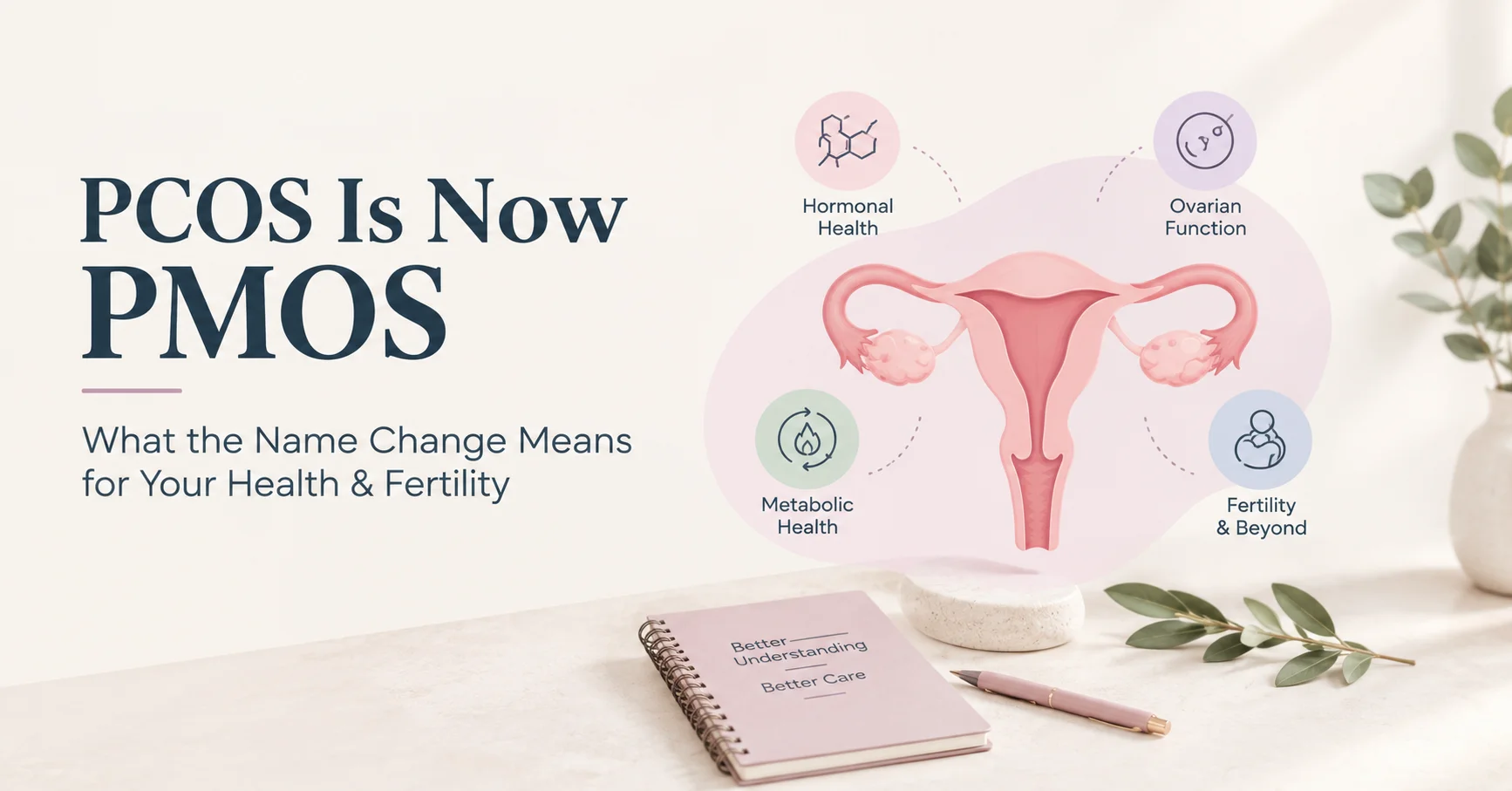

PCOS Is Now PMOS: What the Name Change Means for Your Health & Fertility
PCOS is now PMOS
You may have spotted the headlines: the condition you know as PCOS has a new name. If you have been diagnosed, or you are trying for a baby with irregular cycles, it is natural to wonder what this means for you. Let’s walk through it together, one question at a time.
Quick answer: In May 2026, polycystic ovary syndrome (PCOS) was officially renamed polyendocrine metabolic ovarian syndrome (PMOS). The new name was published in The Lancet after a global consensus involving around 22,000 patients, doctors, and researchers. The condition itself has not changed. Your diagnosis, treatment and fertility options stay the same. The new name simply describes it more accurately: a lifelong hormonal and metabolic condition, not a problem of “cysts” on the ovaries.
Key takeaways
- PMOS stands for polyendocrine metabolic ovarian syndrome. It affects about 1 in 8 women – around 3.1 million in the UK.
- The old name was misleading. The small “cysts” seen on scans are actually immature egg follicles.
- Nothing changes overnight. The switch happens over a three-year transition, with the new name built into the international guideline in 2028.
- You do not need a new diagnosis, new tests or new medication because of the name change.
- PMOS remains one of the most treatable causes of fertility problems. Most people can conceive with the right support.
If you would rather talk it through with a specialist than read, you can Book a Free Consultation with our fertility team in Elstree.
What does PMOS stand for?
PMOS stands for Polyendocrine Metabolic Ovarian Syndrome. Each word was chosen to describe a real part of the condition.
| Word | What it means | Why it matters to you |
|---|---|---|
| Polyendocrine | Several hormone (endocrine) systems are involved, not just reproductive hormones | Explains symptoms beyond periods, such as excess hair, acne, and mood changes |
| Metabolic | The condition affects how your body handles insulin, sugar, and fats | Highlights higher risks of type 2 diabetes, high cholesterol, and heart disease |
| Ovarian | The ovaries are still involved, through hormone production and how follicles develop | Keeps the link to ovulation, periods and fertility |
| Syndrome | A cluster of features that varies from person to person | No two people with PMOS look exactly alike |
The experts kept the word “ovarian” on purpose. Professor Helena Teede, who led the process, explained that it covers hormonal changes in the ovary and how follicles respond. A name using “reproductive” was considered too stigmatising in many cultures.
PCOS vs PMOS: is it a different condition?
No. PCOS and PMOS are the same condition. If you were told you have PCOS last year, you have PMOS today. Only the label has changed – and with it, the way doctors are encouraged to think about your care.
Why was PCOS renamed?
PCOS was renamed because the old name was inaccurate and was causing real harm. Patients and clinicians had said so for more than a decade.
1. There are no true cysts
The “cysts” seen on an ultrasound are not cysts at all. They are small, immature follicles – each holding an egg – that have paused in their development. And many people with the condition have normal-looking ovaries on a scan.
2. The name delayed diagnosis
Because the name pointed to cysts, some women without them were told they could not have the condition. Others assumed any ovarian cyst meant PCOS. The World Health Organization estimates that up to 70% of people with the condition remain undiagnosed.
3. It hid the whole-body picture
The old name made it sound like a gynaecology problem only. In reality, it affects metabolism, the heart, skin, sleep, and mental health. Care was often split between specialists, with no one looking at the whole person.
4. It carried stigma
In global surveys, avoiding stigma was the top thing people wanted from a new name. It came ahead of ease of communication and scientific accuracy.
Who decided the new name?
The name was chosen by the Global Name Change Consortium, led by Professor Helena Teede at Monash University in Australia. It brought together 56 patient and professional organisations across six continents, including the UK charity Verity, the Endocrine Society, the Androgen Excess and PCOS Society and the American Society for Reproductive Medicine. In the final vote, 87 of 90 panel members backed PMOS straight away. It beat two other shortlisted names: endocrine metabolic ovulatory syndrome and ovulatory metabolic endocrine syndrome.
| When | Milestone |
|---|---|
| 2012 | A US National Institutes of Health panel says the name PCOS is a distraction and should change |
| Oct 2015 | Experts meet in Sicily; all agree the name is poor, but cannot agree a replacement |
| 2017, 2023, 2025 | Three global surveys gather views from about 22,000 people |
| Early 2026 | International workshops test the shortlist; PMOS wins by a landslide |
| 12 May 2026 | PMOS published in The Lancet and announced at the European Congress of Endocrinology in Prague |
| May 2026 onwards | RCOG and NICE confirm they will transition to the new name; ASRM endorses it |
| 2028 | New name to be fully built into the updated International Evidence-Based Guideline |
Did everyone agree?
Not quite, and it is fair to say so. A small number of advocates felt changing the acronym would cause confusion. Some also wanted a name that allowed for a possible male form of the condition, which researchers are still studying. The consortium decided that waiting for that research would delay change for women who need it now.
What changes – and what stays the same?
The condition, the diagnosis, and the treatment all stay the same. What changes is the language, and gradually, the focus of care.
| Area | What stays the same | What is changing |
|---|---|---|
| Your diagnosis | Valid as it is. No retesting is needed | Letters and records may start to say PMOS, or “PMOS (formerly PCOS)” |
| Diagnostic criteria | The 2023 international guideline criteria still apply | Experts are reviewing whether criteria fully reflect the condition |
| Medication | Metformin, the pill, letrozole, and other treatments continue as prescribed | Nothing changes because of the name |
| Fertility treatment | Ovulation induction, IUI, and IVF options are unchanged | Greater attention to metabolic health before and during treatment |
| Long-term care | Lifestyle support remains the foundation | More routine checks of blood sugar, blood pressure and cholesterol |
| NHS paperwork | Prescriptions, coding and insurance forms may say PCOS for a while | NHS systems, NICE and RCOG will switch over during the three-year transition |
Yale Medicine’s experts put it simply: no immediate action is needed because of the name change. What they hope will change is how clinicians think – looking beyond one symptom to your health over a lifetime.
PMOS symptoms and how it is diagnosed
PMOS symptoms usually start in the late teens or early twenties, but they can appear at any age. They vary widely, and you do not need every symptom to have the condition.
Common signs of PMOS
- Irregular, infrequent, or absent periods – often a sign that you are not ovulating regularly
- Difficulty getting pregnant, usually because ovulation is irregular
- Excess facial or body hair (hirsutism) on the face, chest or back
- Acne that persists beyond the teenage years
- Thinning hair or hair loss from the scalp
- Weight gain, or finding weight hard to shift – though many people with PMOS are a healthy weight
- Dark, velvety skin patches in the neck or armpits (acanthosis nigricans), linked to insulin resistance
- Low mood, anxiety or poor body image
How is PMOS diagnosed in adults?
UK doctors currently follow the 2023 International Evidence-Based Guideline, endorsed by the RCOG. In adults, a diagnosis is made when you have at least two of these three features, after other causes have been ruled out:
- Irregular cycles or ovulation problems
- Signs of raised androgens (“male-type” hormones) – either symptoms like excess hair and acne, or raised levels on a blood test
- Polycystic ovarian appearance on ultrasound, or a raised anti-Müllerian hormone (AMH) blood level
So, a scan is not always needed. And if your ovaries look normal, you can still have PMOS.
Your doctor will also check for conditions that can look similar. These include thyroid problems, raised prolactin, and a rare adrenal condition called non-classic congenital adrenal hyperplasia.
What about teenagers?
For adolescents, the rules are stricter. Both irregular cycles and raised androgens are needed, and ultrasound is not recommended within eight years of a first period. That is because many healthy teenage ovaries look “polycystic” on a scan.
Tests you might have at a fertility clinic
If you are trying to conceive, a fertility assessment usually includes hormone blood tests, AMH, a pelvic ultrasound and checks of blood sugar and cholesterol. Your partner, if you have one, will usually have a semen analysis too. You can read more about our female fertility investigations or start with a Fertility Wellness Check.
What the new name means for your long-term health
The word “metabolic” is the biggest shift in the new name. It signals that PMOS is a lifelong condition that affects far more than your periods and fertility.
Insulin resistance: the hidden driver
Many people with PMOS have insulin resistance, regardless of their weight. The body needs more insulin to keep blood sugar steady. High insulin then pushes the ovaries to make more androgens, which disrupts ovulation. This loop is why metabolic health and fertility are so closely tied in PMOS.
Health risks linked to PMOS
| Area | Associated risk | What helps |
|---|---|---|
| Blood sugar | Higher risk of prediabetes, type 2 diabetes and gestational diabetes | Regular glucose checks, often every 1-3 years; lifestyle support; metformin where advised |
| Heart and circulation | Higher blood pressure and unhealthy cholesterol levels | Blood pressure and lipid checks; activity; not smoking |
| Womb lining | Infrequent periods can thicken the lining, raising endometrial cancer risk | Regular bleeds, sometimes with hormonal treatment; report unusual bleeding |
| Mental health | Higher rates of depression, anxiety and eating difficulties | Screening and support; counselling where needed |
| Sleep | Higher risk of obstructive sleep apnoea | Mention snoring or daytime tiredness to your GP |
These are raised risks, not certainties. Many people with PMOS never develop them, especially with early checks and support. That is exactly what the new name is designed to encourage.
Lifestyle: the foundation, not a blame game
Healthy eating, regular activity, good sleep, and stress management help every person with PMOS. For those carrying extra weight, losing even 5-10% of body weight can restore ovulation in some cases. But PMOS is not caused by lifestyle, and weight stigma helps no one. Our article on lifestyle and nutrition for hormone-related infertility has practical, realistic tips.
A note on supplements: You may see inositol, vitamin D, and omega-3 recommended online. The 2023 international guideline considers inositol experimental, with limited evidence for fertility outcomes. Speak to your clinician before starting any supplement, especially while trying to conceive.
PMOS and fertility: can you still get pregnant?
Yes. PMOS is one of the most common causes of fertility problems, but it is also one of the most treatable. Many people with PMOS conceive naturally, and most who need help will conceive with treatment.
Why PMOS affects fertility
The main issue is ovulation. When hormone levels are out of balance, follicles often stop growing before an egg is released. No ovulation means no egg to fertilise. Irregular cycles also make it hard to time sex, and ovulation predictor kits can give misleading results because LH levels may run high. If you want to understand your own odds, read Can You Get Pregnant Naturally with PCOS?
When should you seek help?
The usual advice is to see a specialist after 12 months of trying, or 6 months if you are 35 or over. With PMOS, it is sensible to seek advice sooner – especially if your periods are very irregular or absent. Our fertility guide overview explains the first steps.
The PMOS fertility treatment ladder
Treatment usually starts simple and steps up only if needed. Your plan will depend on your age, your partner’s sperm health, your tubes, and how long you have been trying.
- Lifestyle and preconception care – Optimising weight, activity, sleep and blood sugar can restore ovulation for some people and improve outcomes at every later step. See our preconception care support.
- Ovulation induction with tablets – Letrozole is now the recommended first-line tablet for PMOS, because it gives higher live birth rates than clomifene in trials. Clomifene, sometimes with metformin, remains an option. Treatment is monitored by ultrasound. Learn more about ovulation induction.
- Metformin – This diabetes medicine can improve insulin resistance and cycle regularity. It is sometimes used alone or alongside ovulation tablets, though it is less effective than letrozole for achieving pregnancy on its own.
- Gonadotrophin injections – If tablets do not work, low-dose hormone injections can stimulate ovulation. Close scan monitoring is essential, because the ovaries in PMOS can over-respond.
- Laparoscopic ovarian surgery (“drilling”) – A keyhole procedure that can restore ovulation in some people who do not respond to tablets. It is used less often today. See our page on laparoscopy.
- IUI – Intrauterine insemination combined with ovulation induction may help selected couples, or people using donor sperm.
- IVF – In vitro fertilisation is recommended when other treatments have not worked, or when there are other factors such as blocked tubes or low sperm count.
IVF with PMOS: what is different?
People with PMOS often produce plenty of eggs during IVF. That is good news, but it brings a higher risk of ovarian hyperstimulation syndrome (OHSS). Specialist clinics reduce this risk in several ways:
- Lower, carefully tailored medication doses, with frequent scans and blood tests
- An antagonist protocol, which is the recommended approach for PMOS
- An agonist trigger instead of hCG where appropriate
- “Freeze-all” cycles, where embryos are frozen and transferred later in a calmer cycle through frozen embryo transfer
- Gentler approaches such as Mild IVF, which use lower drug doses
With this care, IVF success for people with PMOS is generally similar to others of the same age. You can view our own success rates and prices.
What about egg freezing?
If you are not ready for a baby yet, egg freezing is an option. People with PMOS often have a good number of eggs collected, though stimulation still needs careful monitoring.
Ready to talk about your options? Every PMOS journey is different. Book a Free Consultation and one of our specialists will help you understand where to start.
Pregnancy with PMOS: what to know
Most people with PMOS have healthy pregnancies and healthy babies. However, PMOS is linked to a higher chance of some pregnancy complications, so a little extra care goes a long way.
Pregnancy risks linked to PMOS
- Gestational diabetes – the most important one to watch for
- High blood pressure and pre-eclampsia
- Preterm birth
- Miscarriage – some studies suggest a higher risk, but much of this appears linked to weight and insulin resistance rather than PMOS itself
Steps to take before and during pregnancy
- Check your blood sugar before you conceive – The international guideline recommends a glucose tolerance test before pregnancy or early on, as people with PMOS are at higher risk of gestational diabetes.
- Take folic acid – Everyone trying to conceive should take it. If your BMI is 30 or above, UK guidance recommends a higher 5 mg dose, which your GP can prescribe.
- Check your blood pressure and review any medicines with your doctor.
- Tell your midwife you have PMOS, so they can plan the right checks.
Our preconception care and pregnancy care services support you from the months before trying right through to early pregnancy. If you have had a loss, our miscarriage and implantation failure investigations look for treatable causes.
What should you do now? A UK checklist
You do not need to do anything urgent because of the name change. But it is a good moment to check that your care covers the whole picture.
- Keep taking your current treatment exactly as prescribed.
- Ask your GP about metabolic checks – blood sugar, blood pressure and cholesterol – if you have not had them recently.
- Expect both names for a while. NHS records, prescriptions and coding may still say PCOS during the transition.
- Use trusted UK sources: the NHS PCOS page, Verity, the UK PMOS charity, and the RCOG.
- Look after your mental health. If low mood, anxiety or eating worries are affecting you, raise them. Our counselling and fertility coaching services can help.
- If you are trying to conceive, do not wait a full year if your cycles are very irregular. Seek fertility advice early.
Where UK guidance stands
The RCOG has welcomed the new name, and both the RCOG and NICE have confirmed they are transitioning to it. Until updated guidance is published, UK clinicians continue to follow the 2023 international guideline. We will update this article as NICE and NHS guidance changes.
How IVF London supports people with PMOS
At IVF London, we look at the whole person, not just the ovaries – which is exactly what the new name asks for. We are licensed by the HFEA and regulated by the CQC, and our clinic is based in Elstree, just outside London.
- Thorough assessment: hormone profile, AMH, ultrasound, metabolic screening and partner testing, so your plan is based on your full picture.
- Step-by-step treatment: from ovulation induction and IUI to IVF, ICSI and frozen embryo transfer – we start with the simplest option likely to work.
- Safety-first stimulation: tailored doses, antagonist protocols, close monitoring and freeze-all strategies to lower OHSS risk.
- Lower-dose options: Mild IVF for people who may over-respond to standard doses.
- Holistic support: preconception care, nutrition guidance, counselling and fertility coaching alongside your treatment.
Not sure where to begin? Our initial consultation explains what to expect, and you can meet our specialist team first. You can also check your egg reserve at home with our Know Your Ovarian Reserve test – though with PMOS, AMH results are best interpreted by a specialist.
Take the next step with confidence
A new name does not change your hopes of building a family. Whether you have just been diagnosed, have been trying for a while or want to plan ahead, our specialists are here to help.
Book a Free Consultation · Call 0208 075 8881 · Email info@ivflondon.co.uk
Frequently asked questions about PMOS
1. Is PMOS the same as PCOS?
Yes. PMOS (polyendocrine metabolic ovarian syndrome) is the new name for PCOS. It is the same condition with the same diagnosis and treatments.
2. Do I need to be re-diagnosed with PMOS?
No. An existing PCOS diagnosis is automatically a PMOS diagnosis. You do not need new tests because of the name change.
3. Will my GP know what PMOS is?
Increasingly, yes, but the change is gradual. The NHS, NICE and RCOG are moving to the new name over a three-year transition. If you are unsure, saying “PMOS, formerly PCOS” avoids any confusion.
4. Should I say PCOS or PMOS now?
Either is understood. Many clinicians and charities use “PMOS (formerly PCOS)” during the transition, and you can do the same.
5. I don’t have cysts on my ovaries. Can I still have PMOS?
Yes. This is one of the main reasons for the new name. You can be diagnosed without any polycystic appearance on a scan if you have irregular cycles and raised androgens.
6. If I have ovarian cysts, does that mean I have PMOS?
Not necessarily. True ovarian cysts, such as functional or dermoid cysts, are different and unrelated. PMOS is diagnosed on a set of criteria, not on cysts alone.
7. Will my medication or treatment change?
No. Metformin, the combined pill, letrozole, anti-androgen treatments and fertility treatments continue as before. Over time, you may simply be offered more regular metabolic checks.
8. Can I get pregnant naturally with PMOS?
Many people can, especially when cycles are fairly regular or ovulation returns with lifestyle changes. If your periods are very irregular or absent, seek advice early, because ovulation induction is simple and effective for most people.
9. Is IVF successful for people with PMOS?
Generally, yes. People with PMOS often have many eggs collected, and success rates are broadly similar to others of the same age. The main extra consideration is preventing OHSS, which specialist clinics manage with tailored protocols.
10. Can you have PMOS if you are slim?
Yes. So-called “lean PMOS” is common. Insulin resistance and hormonal changes can still be present at a healthy weight, so the same assessment applies.
11. Can PMOS be cured?
There is no cure yet, but symptoms can be managed very well. Many people find symptoms change over time, and fertility treatment for PMOS has high success rates.
12. Does weight loss get rid of PMOS?
Weight loss does not cure PMOS, but for people carrying extra weight, a 5-10% reduction can improve cycles, ovulation and metabolic health. It is one tool among many, not the whole answer.
13. Can men get PMOS?
Not by current definitions. Some research suggests male relatives may share related metabolic and hormonal traits, and this is still being studied. It was one reason a minority of experts wanted a name without “ovarian”.
14. Why is “ovarian” still in the name?
The ovaries are still involved through hormone production and follicle development. Experts also felt removing the link to women’s health could divert attention and resources from those affected now.
15. Does PMOS affect NHS IVF funding?
Not on its own. NHS-funded IVF depends on your local integrated care board’s criteria, such as age, BMI, and how long you have been trying. The name change does not alter these rules.
16. Is PMOS a lifelong condition?
Yes. That is why the new name stresses metabolic health. After fertility treatment and after menopause, ongoing checks of blood sugar, blood pressure and cholesterol remain important.
17. Does PMOS increase the risk of miscarriage?
Some studies suggest a higher risk, though much of it may relate to weight and insulin resistance rather than PMOS directly. Managing blood sugar before pregnancy may help. If you have had a loss, talk to a specialist.
18. When will the name change be official in the UK?
It is already official internationally since May 2026. The RCOG and NICE have confirmed they are adopting it, and full adoption is expected with the 2028 international guideline update.

