


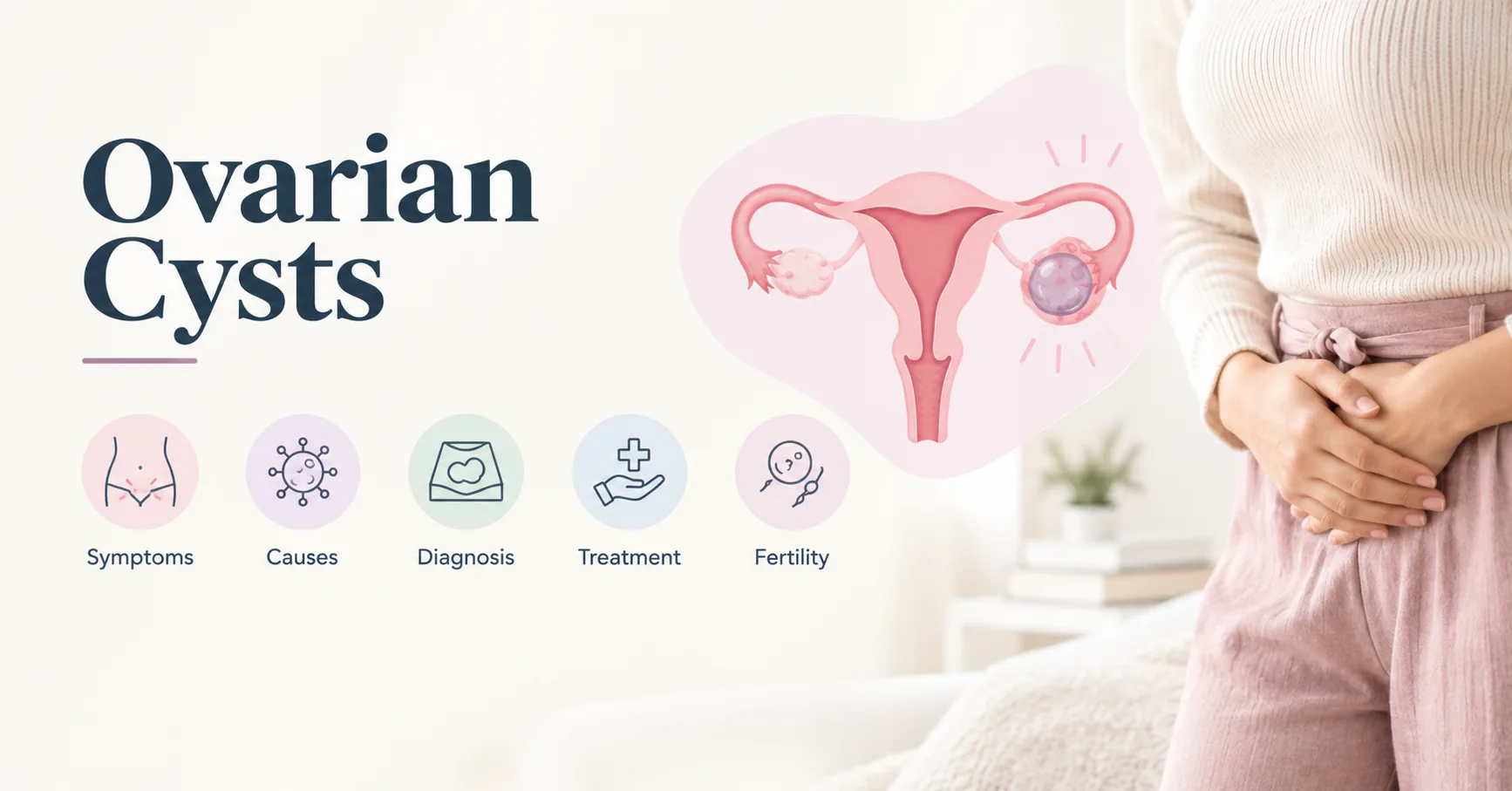

Ovarian Cysts: Symptoms, Causes, Diagnosis, Treatment & Fertility
Ovarian cysts
Hearing the word “cyst” after a scan can be unsettling, especially if you are hoping to start a family. The good news is that most ovarian cysts are harmless, and many disappear on their own. Let’s go through what they are, when to worry and what they mean for your fertility.
Quick answer: An ovarian cyst is a fluid-filled sac that develops on or inside an ovary. Most are functional cysts linked to the normal menstrual cycle, cause no symptoms and go away within a few months without treatment. Some types, such as endometriomas (from endometriosis) or dermoid cysts, may need monitoring or surgery. Ovarian cysts do not usually stop you getting pregnant, but some can make it harder, and any surgery should be planned to protect your egg supply.
Key takeaways
- Ovarian cysts are very common, and most are benign (non-cancerous).
- Many cause no symptoms and are only found on a routine scan.
- Sudden, severe pelvic pain with vomiting, fever or feeling faint needs emergency care.
- Diagnosis is mainly by pelvic ultrasound. Blood tests are used in selected cases.
- Most cysts are simply monitored. Surgery is for cysts that are large, persistent, painful or look unusual.
- Endometriomas and ovarian surgery can lower your egg reserve, so fertility should be discussed before any operation.
If you have been told you have a cyst and are worried about your fertility, you can Book a Free Consultation with our specialists in Elstree.
What is an ovarian cyst?
An ovarian cyst is a sac, usually filled with fluid, that forms on or inside an ovary. Cysts can affect one or both ovaries and range from a few millimetres to more than 10 cm across.
Each month, your ovaries grow small follicles, one of which normally releases an egg. Sometimes this process does not finish as planned, and a follicle keeps growing and filling with fluid. That is the most common way a cyst forms.
Types of ovarian cysts
Ovarian cysts fall into two broad groups: functional cysts, which come from the normal cycle, and pathological cysts, which come from abnormal cell growth or another condition.
| Type | How it forms | Typical behaviour | Effect on fertility |
|---|---|---|---|
| Follicular cyst (functional) | A follicle does not release its egg and keeps growing | The most common type; usually gone within 1-3 cycles | Usually none |
| Corpus luteum cyst (functional) | The follicle reseals after releasing an egg and fills with fluid or blood | Usually resolves; can bleed or cause pain | Usually none; common in early pregnancy |
| Haemorrhagic cyst | Bleeding into a functional cyst | Can cause sudden pain; most settle over weeks | Usually none |
| Endometrioma (“chocolate cyst”) | Endometriosis tissue grows on the ovary and fills with old blood | Does not go away on its own; can grow or come back | Can lower egg reserve; linked to endometriosis-related infertility |
| Dermoid cyst (mature teratoma) | Grows from cells that can form hair, skin or fat | Benign; grows slowly; higher risk of twisting | Usually none directly, but often needs surgery |
| Cystadenoma | Grows from cells on the ovary’s surface; filled with watery or mucus-like fluid | Benign but can become very large | Surgery may affect ovarian tissue |
| Borderline or malignant tumour | Abnormal cell growth | Uncommon, especially before menopause | Needs specialist cancer care; fertility-sparing options may exist |
Are PMOS (PCOS) “cysts” the same thing?
No. People with polyendocrine metabolic ovarian syndrome, the condition recently renamed from PCOS, often have many small follicles on their ovaries. These are immature egg follicles, not true cysts, and they are not treated the same way. Read more in PCOS Is Now PMOS: What the Name Change Means.
Ovarian cyst symptoms
Most ovarian cysts cause no symptoms at all. Symptoms usually appear only if a cyst is large, bleeds, bursts or twists the ovary.
Common symptoms
- Pelvic pain on one side – from a dull, heavy ache to sharp, sudden pain
- Bloating, swelling or a feeling of fullness in the tummy
- Pain during sex
- Pain when opening your bowels
- Needing to pass urine more often, or difficulty emptying your bladder, if the cyst presses on it
- Changes to your periods – heavier, lighter or irregular bleeding
- Feeling full quickly after eating small amounts
- Painful periods, especially with endometriomas
Many of these symptoms are shared with other conditions, including IBS, endometriosis and, less commonly, ovarian cancer. That is why persistent symptoms deserve a proper check rather than guesswork.
When is an ovarian cyst an emergency?
Two complications need urgent care: ovarian torsion, where a cyst twists the ovary and cuts off its blood supply, and a ruptured cyst with heavy internal bleeding. Torsion is a surgical emergency, because quick treatment can save the ovary.
Call 999 or go to A&E if you have:
- Sudden, severe pain in your lower tummy or pelvis
- Pain with nausea and vomiting
- Pain with a high temperature
- Feeling faint, dizzy, very weak or breathing fast
- Pain with a positive pregnancy test, as this could be an ectopic pregnancy
When to see a GP
Book a GP appointment, or use NHS 111, if you have pelvic pain, bloating or period changes that keep coming back. Keeping a simple diary of your symptoms and cycle dates helps your doctor spot patterns. If you are over 50 and have new, persistent bloating or feel full quickly, tell your GP – these symptoms should be checked promptly.
What causes ovarian cysts?
Most ovarian cysts are caused by the normal hormonal changes of the menstrual cycle. Other types come from specific conditions or cell changes. Nothing you did caused your cyst.
Causes by type
- Ovulation itself – functional cysts form when a follicle does not release its egg or does not shrink afterwards.
- Endometriosis – tissue similar to the womb lining grows on the ovary and bleeds each month, forming an endometrioma. Our guide to endometriosis and fertility explains this in detail.
- Early pregnancy – a corpus luteum cyst often supports the pregnancy in its first weeks.
- Abnormal cell growth – dermoid cysts and cystadenomas develop from particular cell types. Why this happens is not fully understood.
- Pelvic infection – rarely, a severe infection can form an abscess involving the ovary and tube.
Risk factors
- Being of reproductive age – functional cysts are most common between puberty and menopause.
- Fertility medication – drugs that stimulate the ovaries can cause temporary cysts. Your clinic will watch for these with scans.
- Hormonal medication – some drugs, such as tamoxifen, are linked to cysts.
- Previous ovarian cysts – people who have had one are more likely to have another.
- Endometriosis – raises the chance of endometriomas.
Can hormonal contraception prevent cysts?
Combined hormonal contraception stops ovulation, so it can reduce the chance of new functional cysts forming. However, research shows it does not make an existing cyst go away faster. If you are worried about using contraception long-term, read Can Birth Control Cause Infertility?
How are ovarian cysts diagnosed?
Ovarian cysts are diagnosed mainly with a pelvic ultrasound scan. Many are found by chance during a scan for something else, including routine fertility checks.
1. Pelvic ultrasound
A transvaginal ultrasound, where a slim probe is placed gently in the vagina, gives the clearest view of the ovaries. It usually takes 10-15 minutes. The scan shows the cyst’s size and whether it looks:
- Simple – thin-walled and filled with clear fluid. These are almost always benign.
- Complex – with solid areas, thick walls, internal divisions or blood flow. These need closer assessment, but most are still benign.
Specialists often use standard scoring systems, such as IOTA rules or O-RADS, to describe how likely a cyst is to be benign.
2. Blood tests
- Pregnancy test – to rule out pregnancy, including ectopic pregnancy.
- CA-125 – a marker that can be raised in ovarian cancer. It is also raised by endometriosis, periods, fibroids and infection. UK guidance says it is not needed for a simple cyst in someone who has not reached menopause.
- Other tumour markers – sometimes checked in younger people with complex cysts.
- AMH – if you are thinking about fertility, this blood test estimates your egg reserve before any treatment.
3. Further imaging
An MRI scan may be used if the ultrasound is unclear, or if a cyst is large. It helps plan surgery.
How UK doctors decide what happens next
For people who have not reached menopause, RCOG guidance broadly works like this:
| Scan finding | Usual approach |
|---|---|
| Simple cyst under 5 cm | Usually resolves within about three cycles; often no follow-up needed |
| Simple cyst 5-7 cm | Repeat ultrasound, often yearly, if you have no symptoms |
| Simple cyst over 7 cm | Further imaging (MRI) or surgery may be considered |
| Complex, solid or unusual features | Specialist review, further tests and often surgery |
| Any cyst with severe or ongoing symptoms | Assessment for surgery |
After menopause, the approach is more cautious. A risk score combining your scan, CA-125 and menopausal status guides whether you are monitored or referred to a specialist team. Your own plan may differ, so always follow your specialist’s advice.
At IVF London, cysts are often picked up during a Fertility Wellness Check or our female fertility investigations.
Ovarian cyst treatment options
Most ovarian cysts need no treatment beyond monitoring. Treatment depends on the cyst’s type and size, your symptoms, your age, whether you have reached menopause and your plans for pregnancy.
1. Watchful waiting (monitoring)
This is the most common approach. If a cyst is small, looks simple and is not causing much trouble, your doctor will usually repeat the scan in 6-12 weeks or a few months. Most functional cysts will have gone by then. If a cyst stays the same or shrinks over a year, you can often be discharged.
2. Pain relief
Simple painkillers such as paracetamol or ibuprofen can help with discomfort while a cyst settles. A warm heat pad can also ease cramping. Check with a pharmacist if you are pregnant or trying to conceive.
3. Hormonal treatment
Hormonal contraception may be offered to reduce the chance of new functional cysts. For endometriomas, hormonal treatment can help control endometriosis pain and may lower the chance of cysts returning after surgery. These treatments are not suitable while trying to conceive.
4. Surgery
Surgery is usually recommended if a cyst:
- is large or keeps growing
- does not go away after several scans
- causes ongoing or severe symptoms
- looks complex or unusual on the scan
- has twisted the ovary (torsion) – an emergency
Laparoscopy (keyhole surgery) is the most common approach. The surgeon makes a few small cuts in the tummy and uses a camera to remove the cyst. Most people go home the same day or the next, and recover in about 1-2 weeks. Read more about laparoscopy at IVF London.
Laparotomy (open surgery) uses a larger cut. It may be needed for very large cysts, or if cancer is suspected. Recovery takes longer, often 6-8 weeks.
| Procedure | What is removed | Fertility impact |
|---|---|---|
| Ovarian cystectomy | Only the cyst; the ovary stays | Preferred when fertility matters, but some healthy ovarian tissue may be lost |
| Unilateral oophorectomy | One ovary | The other ovary can still release eggs each month |
| Bilateral oophorectomy | Both ovaries | Natural egg production stops, and menopause begins |
The removed tissue is usually sent to a laboratory. Your team will share the results within a few weeks.
What about draining a cyst?
Draining (aspirating) a cyst with a needle is not usually recommended, because cysts often refill. It may occasionally be used in specific situations, such as during fertility treatment, under specialist care.
Before any ovarian surgery: if you may want children, ask about your fertility first. An AMH test and scan can show your egg reserve, and egg freezing or embryo freezing may be worth discussing, especially if both ovaries are affected or you have had ovarian surgery before.
Ovarian cysts and fertility
Most ovarian cysts do not affect fertility. Functional cysts are a sign that your ovaries are working, and they usually clear on their own. The cysts that matter most for fertility are endometriomas, cysts that lead to ovarian surgery, and conditions that come with cysts, such as endometriosis.
Can you get pregnant with an ovarian cyst?
Yes, in most cases. A cyst on one ovary does not stop the other ovary from releasing eggs, and many people conceive naturally with a small cyst. The NHS notes that cysts do not usually prevent pregnancy, although some can make it harder.
How different cysts affect fertility
| Cyst type | Fertility effect | What usually helps |
|---|---|---|
| Functional cysts | Usually none; may briefly delay a cycle | Monitoring; trying as normal |
| Endometrioma | Linked to lower egg reserve, pelvic scarring and blocked tubes | Specialist assessment; early fertility planning; IVF if needed |
| Dermoid / cystadenoma | Little direct effect, but surgery can remove healthy tissue | Careful, ovary-sparing surgery |
| Cysts needing repeated surgery | Each operation can reduce egg reserve | Check AMH first; consider egg or embryo freezing |
Endometriomas: the key fertility concern
Endometriomas are found in a significant proportion of people with endometriosis. They can damage nearby ovarian tissue and may lower AMH levels over time. Endometriosis itself can cause inflammation and scarring that affects the tubes and egg quality.
Surgery to remove an endometrioma can ease pain. But it also removes some healthy ovarian tissue, and studies consistently show AMH and egg numbers can fall afterwards, especially when both ovaries are operated on. That is why the decision needs careful thought.
Should a cyst be removed before IVF?
Not routinely. The 2022 ESHRE endometriosis guideline moved away from removing endometriomas before IVF just to improve pregnancy chances. Surgery is now usually reserved for cases where:
- pain is significant
- the cyst looks unusual and cancer needs to be ruled out
- the cyst blocks safe access to follicles during egg collection
Recent research supports going straight to IVF for many people without these reasons. Your specialist will weigh your age, AMH, cyst size and any past surgery.
Cysts during fertility treatment
It is common to find a small functional cyst on a baseline scan before stimulation. Depending on its size and hormone levels, your clinic may:
- start treatment as planned
- wait for the next cycle for it to clear
- occasionally drain it before starting
Fertility medication can also cause temporary cysts, and stimulated ovaries have a small risk of twisting. That is why ovulation induction, IUI and IVF all involve regular scans. For people with lower egg reserve after surgery, gentler approaches such as Mild IVF or Natural Cycle IVF may suit.
Protecting your future fertility
If you are not ready for a baby but have endometriomas, recurring cysts or upcoming ovarian surgery, fertility preservation is worth discussing. You can check your egg reserve with our Know Your Ovarian Reserve test and review the results with a specialist.
Worried a cyst could affect your chances? Our specialists can review your scans and hormone results and explain your options clearly. Book a Free Consultation.
Ovarian cysts in pregnancy
Ovarian cysts in pregnancy are common and usually harmless. Most are corpus luteum cysts, which help produce hormones in the first weeks and tend to fade by around the second trimester.
A cyst is often found at an early or dating scan. Your team will usually just monitor it. Surgery is only considered if a cyst is large, looks unusual or causes torsion. Where possible, planned surgery is delayed until around 14-16 weeks, when the pregnancy is more settled.
If you have severe or one-sided pain in pregnancy, seek help urgently. Our pregnancy care team supports patients through early pregnancy after treatment.
Ovarian cysts after menopause
Ovarian cysts are less common after menopause, because ovulation has stopped. Most are still benign. However, the risk of cancer is slightly higher at this stage, so doctors take a more careful approach.
- A scan and a CA-125 blood test are usually done together.
- A small, simple cyst with a normal CA-125 is often monitored with repeat scans over a year.
- Cysts with concerning features are referred to a specialist gynaecology or cancer team.
Are ovarian cysts cancerous?
The vast majority of ovarian cysts are not cancer. Around 80% of ovarian cysts are benign overall, and in people who have not reached menopause, the chance of cancer is lower still. Simple, fluid-filled cysts are very rarely cancerous.
Things that make doctors look more closely include:
- solid areas, thick walls or blood flow within the cyst on scan
- fluid in the tummy (ascites)
- being post-menopausal
- a raised CA-125, especially after menopause
- a strong family history of ovarian or breast cancer, or a known BRCA gene change
If further tests are needed, it does not mean you have cancer. It means your team wants to be certain. Borderline tumours, if found, are often treatable with fertility-sparing surgery in younger people.
Living with an ovarian cyst: what to do next
If you have just been told you have a cyst, these steps help you stay informed and in control.
- Ask what type of cyst it is, its size, and whether it looks simple or complex.
- Ask when your follow-up scan is, and what would change the plan.
- Know the emergency signs – sudden severe pain, vomiting, fever or fainting mean A&E.
- Keep a symptom and cycle diary to share at appointments.
- If you want children now or later, mention it early, especially before any surgery.
- Ask for an AMH test if you have endometriomas, cysts on both ovaries or previous ovarian surgery.
- Look after your wellbeing. Waiting for scans can be stressful. Our counselling and fertility coaching services are here if you need them.
How IVF London can help
At IVF London, we see many people whose cysts were found during fertility checks. Our role is to make sure every decision about your ovaries also protects your chance of a family. We are licensed by the HFEA and regulated by the CQC, and our clinic is in Elstree, just outside London.
- Clear diagnosis: detailed transvaginal ultrasound, hormone tests and AMH to understand the cyst and your egg reserve together.
- Fertility-first advice: honest guidance on whether to monitor, operate or go straight to treatment.
- Full treatment range: ovulation induction, IUI, IVF and ICSI, and frozen embryo transfer.
- Fertility preservation: egg and embryo freezing before ovarian surgery, if it is right for you.
- Whole-person support: preconception care, counselling and coaching throughout.
You can learn what happens at your initial consultation, meet our specialist team, and see our success rates and prices.
Get answers, not more worry
A cyst on a scan does not have to mean a cloud over your plans for a family. Whether you have just been diagnosed, are facing surgery or are ready to start treatment, our specialists will help you understand your options.
Book a Free Consultation · Call 0208 075 8881 · Email info@ivflondon.co.uk
Frequently asked questions about ovarian cysts
1. Are ovarian cysts serious?
Usually not. Most are functional cysts that go away on their own within a few months. A small number need surgery, and complications such as torsion or rupture need urgent care.
2. How long does it take for an ovarian cyst to go away?
Functional cysts usually go within one to three menstrual cycles. Endometriomas, dermoid cysts and cystadenomas do not go away on their own.
3. What size ovarian cyst needs surgery?
There is no single cut-off. In UK practice, simple cysts over about 7 cm, cysts that keep growing, painful cysts and those with unusual features are usually considered for surgery. Size is only one factor.
4. Can an ovarian cyst delay my period or cause a missed period?
Yes, sometimes. Functional cysts can affect hormone levels and delay or change a period. If your period is late, take a pregnancy test first.
5. Can an ovarian cyst cause a positive pregnancy test?
No. Ordinary ovarian cysts do not produce the pregnancy hormone hCG. A positive test with one-sided pain needs urgent checking to rule out an ectopic pregnancy.
6. Can I get pregnant with an ovarian cyst?
Yes, most people can. Functional cysts rarely affect fertility. Endometriomas and cysts needing surgery may make it harder, so specialist advice helps.
7. Can I do IVF if I have an ovarian cyst?
Often, yes. Small functional cysts may clear before stimulation starts, and many people with endometriomas go straight to IVF. Your clinic will decide based on the cyst’s type, size and your hormone levels.
8. Does removing an ovarian cyst affect fertility?
It can. Removing the cyst while keeping the ovary protects fertility best, but some healthy tissue may be lost, especially with endometriomas. Ask for an AMH test before surgery if you want children.
9. Does the pill shrink ovarian cysts?
No. Research shows the combined pill does not make existing cysts disappear faster. It may reduce the chance of new functional cysts forming.
10. Can ovarian cysts cause weight gain or bloating?
Large cysts can cause a swollen tummy and bloating, and you may feel full quickly. Cysts themselves do not usually cause true weight gain. Ongoing bloating, especially over 50, should be checked by a GP.
11. What does a ruptured ovarian cyst feel like?
Often a sudden, sharp pain on one side of the lower tummy, sometimes after sex or exercise. Many settle with rest and pain relief. Severe pain, fainting or vomiting need emergency care.
12. Can I exercise or have sex with an ovarian cyst?
Usually yes, if it is not painful. Your doctor may advise avoiding strenuous activity with a large cyst because of the torsion risk. Stop and seek help if you get sudden severe pain.
13. Can ovarian cysts come back?
Yes. Functional cysts can recur with future cycles. Endometriomas can also return after surgery, which is why long-term endometriosis management matters.
14. Is a complex ovarian cyst cancer?
Not necessarily. Complex cysts include haemorrhagic cysts, endometriomas and dermoid cysts, which are all usually benign. They simply need more careful assessment.
15. Can diet or natural remedies get rid of ovarian cysts?
There is no good evidence that diet, supplements or herbal remedies shrink ovarian cysts. A healthy lifestyle supports overall and fertility health, but cysts that persist need medical review.
16. Is an ovarian cyst the same as PMOS (PCOS)?
No. PMOS is a hormonal and metabolic condition. The small follicles seen on scans in PMOS are not true cysts and are managed differently.
17. Can you have a cyst on both ovaries?
Yes. Endometriomas and dermoid cysts often affect both ovaries. When both are involved, protecting ovarian tissue during any surgery is especially important.

